Continuing in our series of the Top Five flicks to watch while imbibing VAVINO's finest, we move on to pick #3, a movie that was released in 2004, the year Virginia winery openings skyrocketed (about 30 new wineries opened between 2003 and 2006), and the year the Notebook blogmasters ramped up our winery hopping in a very big way:
Sideways
This movie came out ten years ago, but you still hear the movie and its characters mentioned in tasting rooms all over the country (especially if Merlot is brought out during the tasting process). The movie was a sleeper box office hit and Award winner (nominated for multiple Oscars including Best Picture), and its impact on the general wine buying public was so widespread that Merlot sales nationwide actually declined by about 25% between 2004 and 2006! And, on the flip side, American interest in Pinot Noir increased by about the same percentage.
The movie is actually more of a deep character study than a film about wine and vineyards, but the cinematography during Miles' and Jack's escapade into central California coast wine country is beautiful and the idea of "bringing your buddy out for partying before tieing the knot" is not too far removed from other male bonding comedies, particularly Swingers.
Most wine fans have seen this film so there's no need to delve too much into the plot. Director Alexander Payne knows how to hook an audience with real characters and believable situations (his other films include About Schmidt with Jack Nicholson, The Descendants with George Clooney and most recently, Nebraska, with Bruce Dern). For Sideways, realism is not as high when Miles and Jack enter the tasting rooms (the blogmasters, two straight guys into wine and tasting rooms, have never hooked up with women at restaurants near wineries, or women working in tasting rooms, who are 100% unattached). But the friendship between Miles and Jack, on opposite ends of the spectrum regarding their respective outlooks on life, is undoubtedly one of the best Hollywood friendships in '00s cinema.
The movie is filled with colorful vulgarity and some intense sex scenes (not to mention some hilarious full frontal male nudity), so you'll never see this movie showing during business hours in a tasting room (compared to our soon-to-be-revealed second and first choices as quintessential winery movies).
So, if you haven't seen this wonderful film, you may be asking "why did Merlot sales drop by 25% after this movie came out?" Miles, wonderfully played by Paul Giamatti (who brought some of Miles into every character he's played since, including John Adams), makes his disdain for the red wine (which was booming in popularity with yuppies in the 1990s) well-known (complete with the F word), when his traveling, soon-to-be-hitched, womanizing buddy Jack insists he keeps his mouth shut if their dates want to order Merlot at a restaurant. Jack is played by Thomas Hayden Church, then only known to most viewers from TV's "Wings," and embodied Jack to the point where you simply cannot imagine any other actor (including superstars like George Clooney or Brad Pitt) in the role.
The film also introduced Pinot Noir to many Americans, who actively sought out the temperamental grape and wine after hearing Miles obsess over it. Miles also mentions Riesling (in a positive context) and Virginia's red Cabernet Franc (in a negative context) in the film, but luckily the comment about Cab Franc didn't deter wine newbies from trying that varietal in Virginia tasting rooms.
There are millions of people who adore this movie, and almost as many who detest it. The bloggers have encountered many people (mostly women, for some strange reason) who hate the movie. While Jack's (and to a lesser degree, Miles') actions are not always sympathetic, this is a character study, not a silly slapstick yuckfest where males do stereotypical "dumb guy" (and pathetic) things (aka The Hangover and the sequels).
To fully enjoy (or enjoy for the fourth or fifth time) Sideways, bottles of Pinot Noir (and Riesling) are highly encouraged. Virginia is not as well-suited to Pinot Noir growing compared to central and northern coast California, Oregon and New York's Finger Lakes (the film explains why Pinot Noir is so finicky to grow). But a few wineries in the Commonwealth, which boast vineyards at higher elevations compared to most other wineries in the state, offer Pinot Noir. Of course, don't expect a Pinot Noir with the complexity (and high ABV) of an Oregon and Sonoma Pinot, but these winery's Pinots are unique in their own way:
Rockbridge Vineyard (north of Lexington)
Afton Mountain Vineyards (south of Waynesboro)
Ox Eye Vineyards (Staunton)
As for Riesling, another difficult-to-grow grape in Virginia, visit these tasting rooms:
Shenandoah Vineyards (near Woodstock, VA)
Prince Michel Vineyards (south of Culpeper)
Doukenie Winery (Loudoun County)
To whet (or re-whet) your palate for Sideways, check out this clip, one of the quietest and most emotional scenes in the film, where Miles' love interest Maya (played by Oscar nominated Virginia Madsen) explains what wine means to her:
And click here if you missed the Notebook's last two top Vino Movie entries (#4 and 5).

Showing posts with label vineyards. Show all posts
Showing posts with label vineyards. Show all posts
Saturday, May 17, 2014


Saturday, May 3, 2014
Virginia Varietal Spotlight: Petit Verdot
To fans of Virginia wine, Cab Franc may be the be-all, end-all of red varietals common to the Commonwealth. As the earthy, smooth red grows so well in the state, it's easy to understand why (you'd be hard presssed to visit a Virginia winery that does not offer a Cab Franc). But other reds are snapping at Cab Franc's heels, with promises to stand beside Franc as the signature red representing the state.
Petit Verdot belongs on that list of reds, along with Norton, Chambourcin, and up and comers like Lemberger. Petit Verdot is known throughout the world as a Bordeaux blend, commonly used along with Merlot, Malbec, Cab Franc and/or Cab Sauv, to create popular wines such as Meritage. When used for blending, Petit Verdot is usually on the lower end of the scale (below 10% in some cases), mainly to add tanins and complexity to the wine. However stand-alone Petit Verdot is gaining acclaim and popularity, especially in Virginia (as well as California, Texas and Washington state), due to its ability to age gracefully and accompany hearty meat dishes. But, like many other unique New World reds, stand-alone Petit Verdot may get some getting used to.
We discovered stand-alone Petit Verdot about seven years ago at Glen Manor Vineyards. Their 2005 Petit Verdot is the most prized bottle on David's wine rack, at the time pretty expensive ($28), but getting better by the year. Given its complex character, the notes that surround Petit Verdot range from vanilla and nutmeg to blackberry and plum to licorace and molasses. Petit Verdot tends to have a high alcohol content, only adding to its ability to age gracefully. Most Petit Verdots from a recent year that we've tried had a bit too much bite to them. In the "open and enjoy now" mindset of many new Virginia wine fans, these notes don't lend well to picking up bottles to go. As a result, most Virginia wineries grow Petit Verdot mainly to blend with other reds.
Glen Manor Vineyards does not offer a stand-alone Petit Verdot at this time. Following in the lead set by winemaker Jeff White's mentor Jim Law of Linden Vineyards, Glen Manor only develops the grape into a stand-alone wine if the growing season and harvest is perfectly suited to the varietal. And given the unpredictable nature of Virginia's weather, this is fairly rare. Besides 2005, Glen Manor offered 2007 and 2009 vintages of Petit Verdot (there is something about those odd numbered years).
Where to try stand-alone Petit Verdot now:
If you don't feel like waiting for the next International Award winning Petit Verdot produced by Glen Manor, there are other wineries in the state that offer it; their Petit Verdots may not be the perfectionist quality of Glen Manor, but some drinkers may actually prefer the wines offered by other locations. With wine, it's all about the taste buds of the participant. Below are wineries (hyperlinked to website) that offer distinctive Petit Verdots. Give it a try. And imagine this wine with a juicy steak or warm bowl of stew.
Ingleside Vineyards (Northern Neck)
General's Ridge Vineyards (Northern Neck)
Potomac Point Winery (Stafford)
James River Cellars (north of Richmond)
Willowcroft (Loudoun County)
Roger's Ford Winery (near Culpeper)
Petit Verdot belongs on that list of reds, along with Norton, Chambourcin, and up and comers like Lemberger. Petit Verdot is known throughout the world as a Bordeaux blend, commonly used along with Merlot, Malbec, Cab Franc and/or Cab Sauv, to create popular wines such as Meritage. When used for blending, Petit Verdot is usually on the lower end of the scale (below 10% in some cases), mainly to add tanins and complexity to the wine. However stand-alone Petit Verdot is gaining acclaim and popularity, especially in Virginia (as well as California, Texas and Washington state), due to its ability to age gracefully and accompany hearty meat dishes. But, like many other unique New World reds, stand-alone Petit Verdot may get some getting used to.
We discovered stand-alone Petit Verdot about seven years ago at Glen Manor Vineyards. Their 2005 Petit Verdot is the most prized bottle on David's wine rack, at the time pretty expensive ($28), but getting better by the year. Given its complex character, the notes that surround Petit Verdot range from vanilla and nutmeg to blackberry and plum to licorace and molasses. Petit Verdot tends to have a high alcohol content, only adding to its ability to age gracefully. Most Petit Verdots from a recent year that we've tried had a bit too much bite to them. In the "open and enjoy now" mindset of many new Virginia wine fans, these notes don't lend well to picking up bottles to go. As a result, most Virginia wineries grow Petit Verdot mainly to blend with other reds.
Glen Manor Vineyards does not offer a stand-alone Petit Verdot at this time. Following in the lead set by winemaker Jeff White's mentor Jim Law of Linden Vineyards, Glen Manor only develops the grape into a stand-alone wine if the growing season and harvest is perfectly suited to the varietal. And given the unpredictable nature of Virginia's weather, this is fairly rare. Besides 2005, Glen Manor offered 2007 and 2009 vintages of Petit Verdot (there is something about those odd numbered years).
Where to try stand-alone Petit Verdot now:
If you don't feel like waiting for the next International Award winning Petit Verdot produced by Glen Manor, there are other wineries in the state that offer it; their Petit Verdots may not be the perfectionist quality of Glen Manor, but some drinkers may actually prefer the wines offered by other locations. With wine, it's all about the taste buds of the participant. Below are wineries (hyperlinked to website) that offer distinctive Petit Verdots. Give it a try. And imagine this wine with a juicy steak or warm bowl of stew.
Ingleside Vineyards (Northern Neck)
General's Ridge Vineyards (Northern Neck)
Potomac Point Winery (Stafford)
James River Cellars (north of Richmond)
Willowcroft (Loudoun County)
Roger's Ford Winery (near Culpeper)
Tuesday, January 14, 2014
Monticello AVA Quadrant Series: Southeast
The Monticello AVA is officially "Virginia's Napa." With over 30 wineries (and more to come) surrounding the Charlottesville area, the Monticello AVA contains more vineyards and wineries than most other states.
Those who plan to "hit C'Ville for some wine tasting" should plan their trip accordingly. It's very easy to get lost in the world of Jefferson country wineries. For that reason, we've split the AVA into four quadrants: Northwest, Southwest, Southeast and Northeast.
Each quadrant offers the full spectrum of winery experiences: From industrial, working vineyard vibe, to romantic and intimate, to big event focused spots. With so many wineries in the area, even breaking the AVA down into four sections isn't enough spotlight every location. We'll zoom in on our favorites and also suggest the best route.
We left off in the Southwest quadrant, at Wintergreen Winery, to be precise. A 45 minute drive will take you over to the Southeast Quadrant (don't worry - the drive will go by quickly because of the scenery in these parts). Follow state highway 6 eastbound (which shares the highway with route 29 for about 2 miles), directly through Walton's Country. You may even decide to take a brief detour and check out the Walton Family museum. Those familiar with the classic show from the '70s will recognize the name Rockfish - which is the name of a river that meanders in this part of Virginia (one fork goes through Wintergreen Winery) and a small village that was occasionally described on the show as if it was some major metropolis.
Route 6 will take you away from the mountains a bit, closer to the foothills of the Blue Ridge and the bluffs alongside the James River. The town of Scottsville may be worth a stop for breakfast or lunch (depending on if you overnight near Wintergreen). In Scottsville, take route 20 northbound back towards Charlottesville. The wineries in this region are clustered close together - right next door, in the case of four wineries. Your first stop will be a winery whose namesake needs no introduction: Trump Winery. Being the left-leaning bloggers that we are, we were a bit hesitant to stop by one of The Donald's newest investments. But fair is fair - we are not biased when it comes to wine. And we were absolutely surprised by our experience here (we just ignored the Hummer with the "Don't Tread on Me" license plate in the parking lot).
Trump Winery is the new name for what was formerly called Kluge Estate. If you visited Kluge Estate before they closed in 2009, expect the same type of experience. The tasting room building is identical, although the interior has been upgraded. The winemaker is the same. The inviting tall grove of trees in the picnic area near the parking lot is the same. The views of course are the same. However the wine is better; Kluge specialized in sparkling wines and bold reds. That made for a challenging experience when we visited Kluge on one of the hottest days in 2004--we're not big fans of sparkling wine and bold red in 98 degree heat is not exactly a mouth-watering thought. Kluge was acquired by fellow GOPer Donald Trump in 2009 and Trump worked his magic to acquire highway signs for route 64 immediately. Before the winery was open, his signs were up. (The normal waiting period for these signs is one to two years - and can only be acquired after the winery is open). So obviously The Donald pulled some puppet strings there. Okay, we're off on a tangent - more wine talk, less politics......fine.
Managed by The Donald's son Eric, the folks working at Trump are incredibly hospitable and entertaining. Being an "all purpose" winery, you can spend all day here, as Trump also has a kitchen that serves light fare like flatbread and cheese and sausage plates. Tastings are $8 a pop (that's cheaper than many wineries in Northern Virginia), and the tasting process is slow and leisurely. Several sparkling wines are offered, all of them on the dry side. Of the several sparklings, our favorite was the Chardonnay/Pinot Noir blend (only 5% pinot but that 5% really makes a difference). Chardonnay was our favorite varietal here: Crisp, dry, with notes of pear and apple. In a close second was the Viognier, with its distinct notes of honeydew melon. As for the reds, those familiar with Kluge may remember their well-priced Bordeaux blend called Albemarle Simply Red. When Kluge closed its doors, they had several hundred cases of this stuff to unload, and did so at rock bottom prices. We found Albemarle Red at Safeways, other Virginia wineries (which offered the wine as a surrogate if they were low on a particular red varietal), and the occasional Sunoco station. And at $14 a bottle - to this day we groan about not grabbing more bottles for our collections. Trump replicated this wine, and it's as fantastic as ever, but at $28 a bottle, double the price. This wine is appropriately oaky with notes of black currant and smoke.
All in all we were happy we stopped by and can easily find ourselves back here.
Entrance to Trump Winery:

Located a stone's throw away from Trump Winery is Blenheim Vineyards, which is owned by Dave Matthews. Two celebrity wineries as neighbors, although the crowd you will see enjoying the sustainable tasting room at Blenheim is rather different from the crowd enjoying the elegant, decidedly not sustainable tasting room at Trump. Blenheim employs sustainable practices right down to the screwtops on several of their bottles. This winery packs them in particularly from nearby UVA so arrive early during the weekend for a more intimate experience.
The tasting building is an A-frame like structure that you walk down a hill (or concrete steps near the crush pad) to enter. Inside the building, sound-absorbing wood surrounds you and you're treated to an eastern view of the grounds from the bright tasting counter. The winemaker here is well known in the Commonwealth, Netherlands born and Charlottesville raised Kirsty Harmon, and her vintages are unique and delicious. The wines rotate here from year to year based on the growing season but during our last visit, we enjoyed a Viognier aged in oak that offered a hint of honeysuckle and banana, and on the red side of the scale, their affordable ($15 a bottle) red table wine, blended with Cab Franc, Cab Sauv and Merlot, was our favorite. Past vintages have included chardonnay and a pure cab franc; the winemakers here are perfectionists and prefer to use grapes grown on the property, which also explains the rotating styles.
Entrance to Blenheim Vineyards' tasting room:

Inside Blenheim:

A few miles up route 20 from Trump and Blenheim are two more side-by-side locations: First Colony Winery and Virginia Wineworks. Wineries like the Trump/Blenheim duo and First Colony/Virginia Wineworks are friendly competitors and surely most folks who visit one will most likely visit the other, so all locations win. Plus, the experiences at these side-by-side spots are usually different from one another. First Colony Winery is more of a traditional Virginia spot, with a bright tasting room and several spots inside and out to chill with a bottle of rosé, Meritage or Merlot (our favorite wines during a recent visit). Virginia Wineworks, where Virginia wine legend Michael Shaps perfects his wines, is the definitive industrial winery. The tasting room is in the same building where the wine is barreled and boxed. Shaps also makes wine for other relatively new state wineries like Attimo Winery, near Christiansburg, and Pippin Hill, also in the southeast Monticello AVA quadrant.
We've spotlighted both First Colony and Virginia Wineworks numerous times in past posts. The two wineries share signage off route 20 and gladly refer customers to each other. Virginia Wineworks, about a quarter mile through the trees down the gravel road from First Colony, offers their budget label ("Wineworks") and the slightly higher priced Michael Shaps label. Wineworks is home to the "wine in a box," a great economical concept for parties; just don't expect to age boxed wine for very long. Wineworks has a few picnic tables scattered around the property; not exactly a great cold weather location, but the tasting process is long and highly entertaining; you simply cannot NOT buy a bottle (or four) at Shaps' location. His wines border perfection - both the whites and reds.
First Colony's current mascot (and future winery owner, according to the staff), is Fritz, a friendly and vocal orange tabby who wandered onto the property about 8 years ago as a kitten with two broken legs. Having a resident cat automatically increases the favorable rating of a Virginia winery to the blogmasters, but First Colony is a terrific year around spot.
Fritz, the greeter of First Colony Winery:

If you still have the energy and time after partaking at these four spots, several other Southeast Quadrant locations await you:
Pippin Hill Winery
Wisdom Oak Winery (formerly Sugarleaf)
Jefferson Vineyards
Those who plan to "hit C'Ville for some wine tasting" should plan their trip accordingly. It's very easy to get lost in the world of Jefferson country wineries. For that reason, we've split the AVA into four quadrants: Northwest, Southwest, Southeast and Northeast.
Each quadrant offers the full spectrum of winery experiences: From industrial, working vineyard vibe, to romantic and intimate, to big event focused spots. With so many wineries in the area, even breaking the AVA down into four sections isn't enough spotlight every location. We'll zoom in on our favorites and also suggest the best route.
We left off in the Southwest quadrant, at Wintergreen Winery, to be precise. A 45 minute drive will take you over to the Southeast Quadrant (don't worry - the drive will go by quickly because of the scenery in these parts). Follow state highway 6 eastbound (which shares the highway with route 29 for about 2 miles), directly through Walton's Country. You may even decide to take a brief detour and check out the Walton Family museum. Those familiar with the classic show from the '70s will recognize the name Rockfish - which is the name of a river that meanders in this part of Virginia (one fork goes through Wintergreen Winery) and a small village that was occasionally described on the show as if it was some major metropolis.
Route 6 will take you away from the mountains a bit, closer to the foothills of the Blue Ridge and the bluffs alongside the James River. The town of Scottsville may be worth a stop for breakfast or lunch (depending on if you overnight near Wintergreen). In Scottsville, take route 20 northbound back towards Charlottesville. The wineries in this region are clustered close together - right next door, in the case of four wineries. Your first stop will be a winery whose namesake needs no introduction: Trump Winery. Being the left-leaning bloggers that we are, we were a bit hesitant to stop by one of The Donald's newest investments. But fair is fair - we are not biased when it comes to wine. And we were absolutely surprised by our experience here (we just ignored the Hummer with the "Don't Tread on Me" license plate in the parking lot).
Trump Winery is the new name for what was formerly called Kluge Estate. If you visited Kluge Estate before they closed in 2009, expect the same type of experience. The tasting room building is identical, although the interior has been upgraded. The winemaker is the same. The inviting tall grove of trees in the picnic area near the parking lot is the same. The views of course are the same. However the wine is better; Kluge specialized in sparkling wines and bold reds. That made for a challenging experience when we visited Kluge on one of the hottest days in 2004--we're not big fans of sparkling wine and bold red in 98 degree heat is not exactly a mouth-watering thought. Kluge was acquired by fellow GOPer Donald Trump in 2009 and Trump worked his magic to acquire highway signs for route 64 immediately. Before the winery was open, his signs were up. (The normal waiting period for these signs is one to two years - and can only be acquired after the winery is open). So obviously The Donald pulled some puppet strings there. Okay, we're off on a tangent - more wine talk, less politics......fine.
Managed by The Donald's son Eric, the folks working at Trump are incredibly hospitable and entertaining. Being an "all purpose" winery, you can spend all day here, as Trump also has a kitchen that serves light fare like flatbread and cheese and sausage plates. Tastings are $8 a pop (that's cheaper than many wineries in Northern Virginia), and the tasting process is slow and leisurely. Several sparkling wines are offered, all of them on the dry side. Of the several sparklings, our favorite was the Chardonnay/Pinot Noir blend (only 5% pinot but that 5% really makes a difference). Chardonnay was our favorite varietal here: Crisp, dry, with notes of pear and apple. In a close second was the Viognier, with its distinct notes of honeydew melon. As for the reds, those familiar with Kluge may remember their well-priced Bordeaux blend called Albemarle Simply Red. When Kluge closed its doors, they had several hundred cases of this stuff to unload, and did so at rock bottom prices. We found Albemarle Red at Safeways, other Virginia wineries (which offered the wine as a surrogate if they were low on a particular red varietal), and the occasional Sunoco station. And at $14 a bottle - to this day we groan about not grabbing more bottles for our collections. Trump replicated this wine, and it's as fantastic as ever, but at $28 a bottle, double the price. This wine is appropriately oaky with notes of black currant and smoke.
All in all we were happy we stopped by and can easily find ourselves back here.
Entrance to Trump Winery:

Located a stone's throw away from Trump Winery is Blenheim Vineyards, which is owned by Dave Matthews. Two celebrity wineries as neighbors, although the crowd you will see enjoying the sustainable tasting room at Blenheim is rather different from the crowd enjoying the elegant, decidedly not sustainable tasting room at Trump. Blenheim employs sustainable practices right down to the screwtops on several of their bottles. This winery packs them in particularly from nearby UVA so arrive early during the weekend for a more intimate experience.
The tasting building is an A-frame like structure that you walk down a hill (or concrete steps near the crush pad) to enter. Inside the building, sound-absorbing wood surrounds you and you're treated to an eastern view of the grounds from the bright tasting counter. The winemaker here is well known in the Commonwealth, Netherlands born and Charlottesville raised Kirsty Harmon, and her vintages are unique and delicious. The wines rotate here from year to year based on the growing season but during our last visit, we enjoyed a Viognier aged in oak that offered a hint of honeysuckle and banana, and on the red side of the scale, their affordable ($15 a bottle) red table wine, blended with Cab Franc, Cab Sauv and Merlot, was our favorite. Past vintages have included chardonnay and a pure cab franc; the winemakers here are perfectionists and prefer to use grapes grown on the property, which also explains the rotating styles.
Entrance to Blenheim Vineyards' tasting room:

Inside Blenheim:

A few miles up route 20 from Trump and Blenheim are two more side-by-side locations: First Colony Winery and Virginia Wineworks. Wineries like the Trump/Blenheim duo and First Colony/Virginia Wineworks are friendly competitors and surely most folks who visit one will most likely visit the other, so all locations win. Plus, the experiences at these side-by-side spots are usually different from one another. First Colony Winery is more of a traditional Virginia spot, with a bright tasting room and several spots inside and out to chill with a bottle of rosé, Meritage or Merlot (our favorite wines during a recent visit). Virginia Wineworks, where Virginia wine legend Michael Shaps perfects his wines, is the definitive industrial winery. The tasting room is in the same building where the wine is barreled and boxed. Shaps also makes wine for other relatively new state wineries like Attimo Winery, near Christiansburg, and Pippin Hill, also in the southeast Monticello AVA quadrant.
We've spotlighted both First Colony and Virginia Wineworks numerous times in past posts. The two wineries share signage off route 20 and gladly refer customers to each other. Virginia Wineworks, about a quarter mile through the trees down the gravel road from First Colony, offers their budget label ("Wineworks") and the slightly higher priced Michael Shaps label. Wineworks is home to the "wine in a box," a great economical concept for parties; just don't expect to age boxed wine for very long. Wineworks has a few picnic tables scattered around the property; not exactly a great cold weather location, but the tasting process is long and highly entertaining; you simply cannot NOT buy a bottle (or four) at Shaps' location. His wines border perfection - both the whites and reds.
First Colony's current mascot (and future winery owner, according to the staff), is Fritz, a friendly and vocal orange tabby who wandered onto the property about 8 years ago as a kitten with two broken legs. Having a resident cat automatically increases the favorable rating of a Virginia winery to the blogmasters, but First Colony is a terrific year around spot.
Fritz, the greeter of First Colony Winery:

If you still have the energy and time after partaking at these four spots, several other Southeast Quadrant locations await you:
Pippin Hill Winery
Wisdom Oak Winery (formerly Sugarleaf)
Jefferson Vineyards
Saturday, January 4, 2014
Winter Virginia Winery Scenes
Happy New Year!
Enjoy a few of our favorite winter scenes at Virginia wineries.
Narmada Winery:

Cooper Vineyards:

Chrysalis Vineyards:

Paradise Springs Winery:


The Barns at Hamilton Station:


Fox Meadow Winery:


The road leading to Fox Meadow:

Enjoy a few of our favorite winter scenes at Virginia wineries.
Narmada Winery:

Cooper Vineyards:

Chrysalis Vineyards:

Paradise Springs Winery:


The Barns at Hamilton Station:


Fox Meadow Winery:


The road leading to Fox Meadow:

Friday, December 20, 2013
Video Clips: Monticello AVA Southwest Quadrant
A few short video clips of the Notebook's adventures in Nelson County and the Southwest Monticello Quadrant:
Afton Mountain Vineyards (spring 2011):
Democracy Vineyards (spring 2013):
Wintergreen Winery (fall 2012):
Afton Mountain Vineyards (spring 2011):
Democracy Vineyards (spring 2013):
Wintergreen Winery (fall 2012):
Sunday, December 8, 2013
Monticello AVA Quadrant Series: Southwest
The Monticello AVA is officially "Virginia's Napa." With over 30 wineries (and more to come) surrounding the Charlottesville area, the Monticello AVA contains more vineyards and wineries than most other states. Those who plan to "hit C'Ville for some wine tasting" should plan their trip accordingly. It's very easy to get lost in the world of Jefferson country wineries. For that reason, we've split the AVA into four quadrants. Each quadrant offers the full spectrum of winery experiences: From industrial, working vineyard vibe, to romantic and intimate, to big event focused spots. With so many wineries in the area, even breaking the AVA down into four sections isn't enough spotlight every location. We'll zoom in on our favorites and also suggest the best route.
The Southwest quadrant sits south of Interstate 64 and the village of Crozet. Most wineries are located in Nelson County, and the vineyards share the land with several microbreweries (Blue Mountain, Wild Wolf, Devil's Backbone). Every time we visit this section of the Monticello AVA, we're torn between Virginia beer and wine. Sometimes we go for both - the view at Blue Mountain Brewery in Afton is second to none, and nothing caps a perfect wine tasting day than a brat and icy cold Full Nelson while looking over the mountains. But back to the grapes....
The Southwest Quadrant houses several of the Notebook's very favorite wineries, so it will be difficult to pin down just four for this spotlight. Your main highways will be route 29 (follow signs for Lynchburg) and county routes 6 and 151. 6 and 151 share the road for several miles until they split near the village of Nellysford. There is adequate signage for the wineries and the routes in this region; Nelson County is proud of its wine trail and makes it easy for anyone, with or without map or GPS, to find their wineries.
At the northernmost trip of this quadrant lies Afton Mountain Vineyards, which changed hands about four years ago and upgraded its tasting room (which formerly was a tight cabin along the private drive leading to the vineyards). The updated tasting room offers one of the finest views in the area, of the mountaintops and a large pond. The Mediterranean-style tasting room is inviting in every season, and the owners are usually on hand to welcome guests. This location grows varietals that are unique (for Virginia), due to its elevation (1000 feet above sea level) and shielded from excessive rain by the Blue Ridge "rain shadow," and dried by the prevailing breezes flowing through the nearby Rockfish and Humpback gaps. Virginia is not particularly known for Pinot Noir, but Afton Mountain Vineyards offers one that is intriguing; the Pinot Noir vines were planted in 1978 and therefore can be labeled "old vines" (for Virginia). Don't expect Oregon or Russian River style here; this Pinot is more akin to traditional French Burgundy, relatively lower alcohol, with a kiss of sweetness, but not overly sweet. Another unusual (for the Commonwealth) wine here is Festa di Bacco, a Super Tuscan style blend of Sangiovese with Merlot, offering wonderful notes of coffee and prunes.
The reds are the star here (they also offer a few Virginia mainstays such as Petit Verdot and Cab Franc). However white lovers won't leave disappointed--they are one of the few state vineyards that has mastered Gewürtztraminer (again thanks to their elevation) and the up and comer alternative to Viognier, Albariño. And they begin their tastings with a sparkling blend of Pinot Noir and Chardonnay.
View from Afton Mountain Vineyards:

You will pass several other vineyards (and a brewery) on the way to the next three spotlighted locations, which are deeper in the southwest quadrant, but well worth the effort to find them. Stop #2 is Democracy Vineyards, which was a presence at state festivals for several years before opening its doors as a winery in 2012. Located on a long and winding road off route 29, Democracy Vineyards boasts one of the most unusual tasting room buildings we've experienced. Their wine is exceptional; having Monticello AVA maestro Michael Shaps as the winemaker isn't too shabby for a relatively new spot. The wine is well-priced too, meaning you can grab a case here and not feel broke. The theme here is recent U.S. history; the winery owners have deep political roots and regardless of your party affiliation, you will find some fascinating newspaper and magazine clippings and posters in the tasting room. The wines have names like Emancipation and Declaration, and the labels are adorned in red, white and blue and patriotic images. The view from the tasting room is more "looking up" compared to Afton Mountain, and because of its young age, you could very well have the place to yourself during your visit. Our favorite wines were the Suffrage, an extremely tasty Chambourcin with notes of strawberry and cinnamon, and the aforementioned Declaration, a wonderful white blend of Chardonnay, Viognier and Petit Manseng; a sweet beginning (courtesy of the Petit Manseng) and a satisfying bone dry ending, perfect for shellfish. The tasting room offers a highly unusual touch - garage doors. They open up during warm months and provide a spectacular view:

The unusual tasting building at Democracy:

Stop #3 is a ten minute drive down the gravel road from Democracy, and has the distinct reputation of being the oldest operating tasting room in the state: Mountain Cove Vineyards. Al Weed (who has dabbled in local politics as well as crafting wine) offers visitors a truly Virginia wine tasting experience. The tasting room is located inside a ramshackle cabin that hasn't been updated since the mid 70s (the tasting room opened in 1974). Al's wine selection has not changed for many years - a red blend called "Tinto," a delicious (and light) red blend of Cabernet Franc and Chambourcin, and Skyline White, their signature wine and the only winery in Virginia still producing this much wine from Villard Blanc variety, slightly sweet with a touch of effervescence. And then there are the fruit wines: Apple, peach and blackberry, which will please fans who may have been disappointed at the dry offerings at stop 2 (Democracy). The name Mountain Cove derives from the location; the vineyards and winery are surrounded by peaks of the Blue Ridge and one feels as if he or she has been temporarily beamed to southern Germany. Al doesn't plan on offering new varietals anytime soon; these are the wines he does best. And with no bottle over $15, you can load up.

The final stop must be in the top ten of Notebook favorites, based on the number of times we've spotlighted this location. Wintergreen Winery is located off county highway 151, near the entrance to Wintergreen Resort. Nestled along the babbling Rockfish River, Wintergreen offers the best of both worlds: A large events building and an intimate tasting room and gift shop perfect for finding holiday gifts for the wino in your family. The star varietal here is Chardonnay; Black Rock Chardonnay offers the perfect combination of crispness and mellow oak (and the bloggers are not fans of oaky whites). Blends rule supreme here and on the red side of the scale, Three Ridges Red gets two enthusiastic thumbs up; a blend of Chambourcin, Cabernet Franc and Merlot, with distinct notes of cigar and tart cherry. This red can be paired with pretty much anything, from shellfish to pasta, mainly due to its blending of lighter and more mineral reds (Chambourcin and Cab Franc, respectively). The picnic tables next to the Rockfish River are inviting every time of the year, including winter if you've brought your coat. Things don't get more relaxing than imbibing in Wintergreen's blends and listening to the babbling river.

There are many other stops in this quadrant of the Monticello AVA that we've spotlighted before. Really, you can't go wrong with this section of Virginia. Wine it, and/or beer it - enjoy the fruits of Jefferson's beloved Monticello AVA.
Featured winery links:
Afton Mountain Vineyards
Democracy Vineyards
Mountain Cove Vineyards
Wintergreen Winery
Other Southwest Monticello AVA wineries:
Veritas Vineyard
Cardinal Point Winery
DelFosse Vineyards
Flying Fox Vineyard
Lovingston Winery
The Southwest quadrant sits south of Interstate 64 and the village of Crozet. Most wineries are located in Nelson County, and the vineyards share the land with several microbreweries (Blue Mountain, Wild Wolf, Devil's Backbone). Every time we visit this section of the Monticello AVA, we're torn between Virginia beer and wine. Sometimes we go for both - the view at Blue Mountain Brewery in Afton is second to none, and nothing caps a perfect wine tasting day than a brat and icy cold Full Nelson while looking over the mountains. But back to the grapes....
The Southwest Quadrant houses several of the Notebook's very favorite wineries, so it will be difficult to pin down just four for this spotlight. Your main highways will be route 29 (follow signs for Lynchburg) and county routes 6 and 151. 6 and 151 share the road for several miles until they split near the village of Nellysford. There is adequate signage for the wineries and the routes in this region; Nelson County is proud of its wine trail and makes it easy for anyone, with or without map or GPS, to find their wineries.
At the northernmost trip of this quadrant lies Afton Mountain Vineyards, which changed hands about four years ago and upgraded its tasting room (which formerly was a tight cabin along the private drive leading to the vineyards). The updated tasting room offers one of the finest views in the area, of the mountaintops and a large pond. The Mediterranean-style tasting room is inviting in every season, and the owners are usually on hand to welcome guests. This location grows varietals that are unique (for Virginia), due to its elevation (1000 feet above sea level) and shielded from excessive rain by the Blue Ridge "rain shadow," and dried by the prevailing breezes flowing through the nearby Rockfish and Humpback gaps. Virginia is not particularly known for Pinot Noir, but Afton Mountain Vineyards offers one that is intriguing; the Pinot Noir vines were planted in 1978 and therefore can be labeled "old vines" (for Virginia). Don't expect Oregon or Russian River style here; this Pinot is more akin to traditional French Burgundy, relatively lower alcohol, with a kiss of sweetness, but not overly sweet. Another unusual (for the Commonwealth) wine here is Festa di Bacco, a Super Tuscan style blend of Sangiovese with Merlot, offering wonderful notes of coffee and prunes.
The reds are the star here (they also offer a few Virginia mainstays such as Petit Verdot and Cab Franc). However white lovers won't leave disappointed--they are one of the few state vineyards that has mastered Gewürtztraminer (again thanks to their elevation) and the up and comer alternative to Viognier, Albariño. And they begin their tastings with a sparkling blend of Pinot Noir and Chardonnay.
View from Afton Mountain Vineyards:

You will pass several other vineyards (and a brewery) on the way to the next three spotlighted locations, which are deeper in the southwest quadrant, but well worth the effort to find them. Stop #2 is Democracy Vineyards, which was a presence at state festivals for several years before opening its doors as a winery in 2012. Located on a long and winding road off route 29, Democracy Vineyards boasts one of the most unusual tasting room buildings we've experienced. Their wine is exceptional; having Monticello AVA maestro Michael Shaps as the winemaker isn't too shabby for a relatively new spot. The wine is well-priced too, meaning you can grab a case here and not feel broke. The theme here is recent U.S. history; the winery owners have deep political roots and regardless of your party affiliation, you will find some fascinating newspaper and magazine clippings and posters in the tasting room. The wines have names like Emancipation and Declaration, and the labels are adorned in red, white and blue and patriotic images. The view from the tasting room is more "looking up" compared to Afton Mountain, and because of its young age, you could very well have the place to yourself during your visit. Our favorite wines were the Suffrage, an extremely tasty Chambourcin with notes of strawberry and cinnamon, and the aforementioned Declaration, a wonderful white blend of Chardonnay, Viognier and Petit Manseng; a sweet beginning (courtesy of the Petit Manseng) and a satisfying bone dry ending, perfect for shellfish. The tasting room offers a highly unusual touch - garage doors. They open up during warm months and provide a spectacular view:

The unusual tasting building at Democracy:

Stop #3 is a ten minute drive down the gravel road from Democracy, and has the distinct reputation of being the oldest operating tasting room in the state: Mountain Cove Vineyards. Al Weed (who has dabbled in local politics as well as crafting wine) offers visitors a truly Virginia wine tasting experience. The tasting room is located inside a ramshackle cabin that hasn't been updated since the mid 70s (the tasting room opened in 1974). Al's wine selection has not changed for many years - a red blend called "Tinto," a delicious (and light) red blend of Cabernet Franc and Chambourcin, and Skyline White, their signature wine and the only winery in Virginia still producing this much wine from Villard Blanc variety, slightly sweet with a touch of effervescence. And then there are the fruit wines: Apple, peach and blackberry, which will please fans who may have been disappointed at the dry offerings at stop 2 (Democracy). The name Mountain Cove derives from the location; the vineyards and winery are surrounded by peaks of the Blue Ridge and one feels as if he or she has been temporarily beamed to southern Germany. Al doesn't plan on offering new varietals anytime soon; these are the wines he does best. And with no bottle over $15, you can load up.

The final stop must be in the top ten of Notebook favorites, based on the number of times we've spotlighted this location. Wintergreen Winery is located off county highway 151, near the entrance to Wintergreen Resort. Nestled along the babbling Rockfish River, Wintergreen offers the best of both worlds: A large events building and an intimate tasting room and gift shop perfect for finding holiday gifts for the wino in your family. The star varietal here is Chardonnay; Black Rock Chardonnay offers the perfect combination of crispness and mellow oak (and the bloggers are not fans of oaky whites). Blends rule supreme here and on the red side of the scale, Three Ridges Red gets two enthusiastic thumbs up; a blend of Chambourcin, Cabernet Franc and Merlot, with distinct notes of cigar and tart cherry. This red can be paired with pretty much anything, from shellfish to pasta, mainly due to its blending of lighter and more mineral reds (Chambourcin and Cab Franc, respectively). The picnic tables next to the Rockfish River are inviting every time of the year, including winter if you've brought your coat. Things don't get more relaxing than imbibing in Wintergreen's blends and listening to the babbling river.

There are many other stops in this quadrant of the Monticello AVA that we've spotlighted before. Really, you can't go wrong with this section of Virginia. Wine it, and/or beer it - enjoy the fruits of Jefferson's beloved Monticello AVA.
Featured winery links:
Afton Mountain Vineyards
Democracy Vineyards
Mountain Cove Vineyards
Wintergreen Winery
Other Southwest Monticello AVA wineries:
Veritas Vineyard
Cardinal Point Winery
DelFosse Vineyards
Flying Fox Vineyard
Lovingston Winery
Wednesday, December 4, 2013
NEW WINERY SPOTLIGHT 6: THE BARNS AT HAMILTON STATION
The Notebook confesses that The Barns at Hamilton Station Vineyards is not exactly new, especially since wineries in Loudoun County are opening faster than we can keep track of. However we thought for the past two years that The Barns (as they like to be called) was an offshoot of nearby Hunters Run Wine Barn, partially due to its name. We also knew that Hunters Run's owners, Geri and Greg Nolan, were planning to expand their location, so color us confused.
The Barns, like Hunters Run, is technically located in the small town of Hamilton, which has a distinctive yet small "downtown" that straddles business route 7 between Leesburg and Purcellville. Most folks skip the business route in favor of the more familiar bypass, but there are some charming old homes in Hamilton. Postal codes are wacky in Loudoun County. Notaviva Vineyards, a mere 2 miles from the West Virginia border, is located in Purcellville, according to the post office. However the downtown of Purcellville is about 15 miles away from Notaviva. Sunset Hills Vineyards, which is very close to the Hamilton-listed Barns at Hamilton Station, also has a Purcellville address. One day we'd like to see a historic map of the county to see how these town limits appeared; probably similar to the large "townships" found in other states like Pennsylvania (townships are more like mini counties than traditional towns).
Enough geography....on to the location, and the wine. The Barns at Hamilton Station is, big surprise, located inside a barn, like so many wineries in the county. As the case with nearby Sunset Hills Vineyards and Willowcroft, the barn has been lovingly restored, and the builders incorporated artifacts found scattered around the pre-restoration barn (such as old license plates and rusty tools) into the tasting room décor. While the barn at Sunset Hills received a rather slick upgrade courtesy of crafty Amish carpenters, the barn at Barns at Hamilton Station retains more ruggedness. Plus, a gas fireplace (real wood fire being understandably too hazardous). Wood naturally absorbs sound, so even when the location gets crowded (and the inevitable live band is playing), you can still hear your table's conversation. Needless to say, the interior of The Barns works wonders during the cold months:

The Barn has a lower level that is rented for events (there was a wedding supply "Expo Hall" type exhibit going on the day we visited). Wedding supplies and winery....sounds like a match made in heaven. If there is an event in this space, the parking lot of the Barns at Hamilton Station may look busier than the tasting room itself is, so don't let that discourage you from visiting the winery.
The wine offerings are fairly typical of what you would find in Virginia: Viognier, with notes of apricot and fig; Chardonnay, slightly oaked and a bit more complex than other Chardonnays found in the area; Cab Franc, a bit lighter than other Francs offering notes of cherry; Merlot, a bit light and with a nice hint of oak. Nothing truly remarkable (yet...) about these wines but all good and satisfying. This is a new location and their prices are more competitive than other new wineries, which frequently price their wines on the high side ($25 and up) to make up for initial expenses. You can get away with that pricing in "recession proof" Northern Virginia, so we were pleased with The Barns' decision to keep prices a little lower (however no bottle is less than $20).
Since this winery is in Northern Virginia, expect to wait for a tasting. This is becoming the norm in the area, unless you get out to winery country early (arrive by opening time, 11 AM for most locations). Despite the number of new wineries in Loudoun County, the tasting rooms are always hopping. And Loudoun County now unfortunately suffers from "winery gridlock" on the roads, particularly route 9 (Charles Town Pike) heading from route 7 towards Harpers Ferry and Charles Town, where many wineries dot the highway. The Barns compensates for their busy factor by offering an ancillary tasting table, created with flat piece of wood and two barrels, as well as their regular tasting bar on busy days.
Outside, a deck, with a view of an unusual shaped pond, lets you forget you're only 8 minutes from downtown Leesburg. We were happy to see no McMansions in sight, which is becoming rare for wineries in the county. With such close proximity to the DC area, The Barns make a terrific all-day getaway, and if you crave other wineries, the aforementioned Hunters Run Wine Barn and Sunset Hills Winery are only a few minutes away (relatively speaking, depending on the traffic on route 9....).
The tasting barn at The Barns. Firepits await you outside, but arrive early to grab one:

The deck at The Barns:

Link for winery:
Barns at Hamilton Station
The Barns, like Hunters Run, is technically located in the small town of Hamilton, which has a distinctive yet small "downtown" that straddles business route 7 between Leesburg and Purcellville. Most folks skip the business route in favor of the more familiar bypass, but there are some charming old homes in Hamilton. Postal codes are wacky in Loudoun County. Notaviva Vineyards, a mere 2 miles from the West Virginia border, is located in Purcellville, according to the post office. However the downtown of Purcellville is about 15 miles away from Notaviva. Sunset Hills Vineyards, which is very close to the Hamilton-listed Barns at Hamilton Station, also has a Purcellville address. One day we'd like to see a historic map of the county to see how these town limits appeared; probably similar to the large "townships" found in other states like Pennsylvania (townships are more like mini counties than traditional towns).
Enough geography....on to the location, and the wine. The Barns at Hamilton Station is, big surprise, located inside a barn, like so many wineries in the county. As the case with nearby Sunset Hills Vineyards and Willowcroft, the barn has been lovingly restored, and the builders incorporated artifacts found scattered around the pre-restoration barn (such as old license plates and rusty tools) into the tasting room décor. While the barn at Sunset Hills received a rather slick upgrade courtesy of crafty Amish carpenters, the barn at Barns at Hamilton Station retains more ruggedness. Plus, a gas fireplace (real wood fire being understandably too hazardous). Wood naturally absorbs sound, so even when the location gets crowded (and the inevitable live band is playing), you can still hear your table's conversation. Needless to say, the interior of The Barns works wonders during the cold months:

The Barn has a lower level that is rented for events (there was a wedding supply "Expo Hall" type exhibit going on the day we visited). Wedding supplies and winery....sounds like a match made in heaven. If there is an event in this space, the parking lot of the Barns at Hamilton Station may look busier than the tasting room itself is, so don't let that discourage you from visiting the winery.
The wine offerings are fairly typical of what you would find in Virginia: Viognier, with notes of apricot and fig; Chardonnay, slightly oaked and a bit more complex than other Chardonnays found in the area; Cab Franc, a bit lighter than other Francs offering notes of cherry; Merlot, a bit light and with a nice hint of oak. Nothing truly remarkable (yet...) about these wines but all good and satisfying. This is a new location and their prices are more competitive than other new wineries, which frequently price their wines on the high side ($25 and up) to make up for initial expenses. You can get away with that pricing in "recession proof" Northern Virginia, so we were pleased with The Barns' decision to keep prices a little lower (however no bottle is less than $20).
Since this winery is in Northern Virginia, expect to wait for a tasting. This is becoming the norm in the area, unless you get out to winery country early (arrive by opening time, 11 AM for most locations). Despite the number of new wineries in Loudoun County, the tasting rooms are always hopping. And Loudoun County now unfortunately suffers from "winery gridlock" on the roads, particularly route 9 (Charles Town Pike) heading from route 7 towards Harpers Ferry and Charles Town, where many wineries dot the highway. The Barns compensates for their busy factor by offering an ancillary tasting table, created with flat piece of wood and two barrels, as well as their regular tasting bar on busy days.
Outside, a deck, with a view of an unusual shaped pond, lets you forget you're only 8 minutes from downtown Leesburg. We were happy to see no McMansions in sight, which is becoming rare for wineries in the county. With such close proximity to the DC area, The Barns make a terrific all-day getaway, and if you crave other wineries, the aforementioned Hunters Run Wine Barn and Sunset Hills Winery are only a few minutes away (relatively speaking, depending on the traffic on route 9....).
The tasting barn at The Barns. Firepits await you outside, but arrive early to grab one:

The deck at The Barns:

Link for winery:
Barns at Hamilton Station
Thursday, November 14, 2013
Monticello AVA Quadrant Series: Northwest
The Monticello AVA is officially "Virginia's Napa." With over 30 wineries (and more to come) surrounding the Charlottesville area, the Monticello AVA contains more vineyards and wineries than most other states. Those who plan to "hit C'Ville for some wine tasting" should plan their trip accordingly. It's very easy to get lost in the world of Jefferson country wineries. For that reason, we've split the AVA into four quadrants. Each quadrant offers the full spectrum of winery experiences: From industrial, working vineyard vibe, to romantic and intimate, to big event focused spots. With so many wineries in the area, even breaking the AVA down into four sections isn't enough spotlight every location. We'll zoom in on our favorites and also suggest the best route.
Avoid route 29. We'll say it again in bold. Avoid route 29. Charlottesville has been experiencing incredible growth over the past fifteen years, and the area of route 29 north of C'Ville resembles Route 7 near Baileys Crossroads mixed with Route 50 through Fairfax on a Thursday afternoon. You get, we trust, the point. Avoid route 29. Coming from Northern Virginia, there are other options, regardless of which quadrant you're visiting. For the Northwest quadrant, we suggest taking route 29 to route 33 in Ruckersville, which is very close to the area where route 29 turns into a parking lot. Follow route 33 west (a right turn if you're coming from the DC area) and then follow country road 810. Your GPS or the most recent Virginia Wine Map will surely help you along.
These back roads run parallel with route 29 and are extremely scenic, in any season. Nearby wineries in the northern section of this quadrant include Stone Mountain Vineyards and Kilaurwen Winery, two locations your bloggers wrote about earlier this year. The roads are quite twisty here, so a designated driver is suggested if you stop by these two wineries (especially to tackle the road leading to and from Stone Mountain).
As you approach the area of the AVA where Skyline Drive and the Blue Ridge Mountains meet the Charlottesville area, you'll come across four locations that craft some of the great vinos in the state. Mountfair Vineyards, which sits at the base of the Blue Ridge foothills and is accessible by a gravel road, specializes in bold reds. This is an intimate location; they even have a policy regarding live music: Acoustic only. As the barrel room also serves as the guest room and entertainment room, this rule makes sense. The wines are complex and perfect for aging here. Meritage style blends are their specialty. We loved them all, but if we had to pick a favorite, it would be "Intertwined," 70% Cabernet Sauvignon, 20% Petit Verdot, 10% Cabernet Franc. And white fans, fear not. They occasionally offer a white from a nearby vineyard, and the owner/winemaker has promised to concentrate on white varietals now that he's perfected the reds.
Next stop, White Hall Vineyards. White Hall is a familiar presence in stores around the area, including Safeway. They are a mass producer. But mass production doesn't mean inferior. This is one of the best mass producers in the Commonwealth, and their wines shine in every vintage, particularly their Gewürztraminer, crisp and flowery with just a touch of sweetness. Their Pinot Gris is French style, with a hint of honeysuckle. Petit Manseng, rising in popularity in the state, is another winner, off dry and brimming with citrus fruit flavors and papaya. For those in your group who were overwhelmed by the hearty reds at Mountfair, White Hall will give them something to toast about. (Red fans don't despair: Their Cabernet Sauvignon is a tart yet silky smooth winner).
Stinson Vineyards, about a mile from White Hall, is an outstanding, relatively new location, with enthusiastic owners, a tasting room modeled after a general store, a unique wine aging concrete "egg" (ask your pourers to see it; it's right behind the tasting room), and tasty selections. There is a good variety of dry reds and slightly sweeter whites here. Their Tannat is nicely priced, compared to Northern Virginia locations; a characteristically deep red wine with elderberry notes and a peppery finish. On the other end of the spectrum, their rosé is light, nearly effervescent, with end notes of bacon. Like other wineries in this area of the Commonwealth, prices are right - prices alone justify a long weekend jaunt to the Monticello AVA.
Stinson Vineyards:

The wine "egg" at Stinson:

As you meander closer to the town of Crozet and U.S. highway 250, you may have the inclination to try other spots, and we highly encourage that. Grace Estate Winery was the subject of a recent blog entry, and King Family Vineyards is an all-time Virginia favorite.
Other locations in the Northwest Quadrant that deserve a shout-out:
Moss Vineyards
Glass House Winery
Pollak Vineyards
Winery URLs spotlighted in this post:
Mountfair Vineyards
White Hall Vineyards
Stinson Vineyards
Avoid route 29. We'll say it again in bold. Avoid route 29. Charlottesville has been experiencing incredible growth over the past fifteen years, and the area of route 29 north of C'Ville resembles Route 7 near Baileys Crossroads mixed with Route 50 through Fairfax on a Thursday afternoon. You get, we trust, the point. Avoid route 29. Coming from Northern Virginia, there are other options, regardless of which quadrant you're visiting. For the Northwest quadrant, we suggest taking route 29 to route 33 in Ruckersville, which is very close to the area where route 29 turns into a parking lot. Follow route 33 west (a right turn if you're coming from the DC area) and then follow country road 810. Your GPS or the most recent Virginia Wine Map will surely help you along.
These back roads run parallel with route 29 and are extremely scenic, in any season. Nearby wineries in the northern section of this quadrant include Stone Mountain Vineyards and Kilaurwen Winery, two locations your bloggers wrote about earlier this year. The roads are quite twisty here, so a designated driver is suggested if you stop by these two wineries (especially to tackle the road leading to and from Stone Mountain).
As you approach the area of the AVA where Skyline Drive and the Blue Ridge Mountains meet the Charlottesville area, you'll come across four locations that craft some of the great vinos in the state. Mountfair Vineyards, which sits at the base of the Blue Ridge foothills and is accessible by a gravel road, specializes in bold reds. This is an intimate location; they even have a policy regarding live music: Acoustic only. As the barrel room also serves as the guest room and entertainment room, this rule makes sense. The wines are complex and perfect for aging here. Meritage style blends are their specialty. We loved them all, but if we had to pick a favorite, it would be "Intertwined," 70% Cabernet Sauvignon, 20% Petit Verdot, 10% Cabernet Franc. And white fans, fear not. They occasionally offer a white from a nearby vineyard, and the owner/winemaker has promised to concentrate on white varietals now that he's perfected the reds.
Next stop, White Hall Vineyards. White Hall is a familiar presence in stores around the area, including Safeway. They are a mass producer. But mass production doesn't mean inferior. This is one of the best mass producers in the Commonwealth, and their wines shine in every vintage, particularly their Gewürztraminer, crisp and flowery with just a touch of sweetness. Their Pinot Gris is French style, with a hint of honeysuckle. Petit Manseng, rising in popularity in the state, is another winner, off dry and brimming with citrus fruit flavors and papaya. For those in your group who were overwhelmed by the hearty reds at Mountfair, White Hall will give them something to toast about. (Red fans don't despair: Their Cabernet Sauvignon is a tart yet silky smooth winner).
Stinson Vineyards, about a mile from White Hall, is an outstanding, relatively new location, with enthusiastic owners, a tasting room modeled after a general store, a unique wine aging concrete "egg" (ask your pourers to see it; it's right behind the tasting room), and tasty selections. There is a good variety of dry reds and slightly sweeter whites here. Their Tannat is nicely priced, compared to Northern Virginia locations; a characteristically deep red wine with elderberry notes and a peppery finish. On the other end of the spectrum, their rosé is light, nearly effervescent, with end notes of bacon. Like other wineries in this area of the Commonwealth, prices are right - prices alone justify a long weekend jaunt to the Monticello AVA.
Stinson Vineyards:

The wine "egg" at Stinson:

As you meander closer to the town of Crozet and U.S. highway 250, you may have the inclination to try other spots, and we highly encourage that. Grace Estate Winery was the subject of a recent blog entry, and King Family Vineyards is an all-time Virginia favorite.
Other locations in the Northwest Quadrant that deserve a shout-out:
Moss Vineyards
Glass House Winery
Pollak Vineyards
Winery URLs spotlighted in this post:
Mountfair Vineyards
White Hall Vineyards
Stinson Vineyards
Monday, October 14, 2013
NEW WINERY SPOTLIGHT 5: GRACE ESTATE WINERY
High atop a ridge in the "Northwest Quadrant" of the Monticello AVA (near Crozet and White Hall) lies Grace Estate Vineyard, which opened last year with great fanfare and support of its winemaker, well-known Virginia vineyard presence Jake Busching. Having perfected his winemaking craft at nearby Horton Vineyards, Keswick Vineyards, and most recently Pollak, Busching has been instrumental in advancing the Commonwealth's reputation for high quality red wines. Grace Estate proudly spotlights Busching on their website and at the winery, with the vow to allow the winemaker to experiment with unusual varietals.
A short drive from White Hall Vineyards, Stinson Vineyards, and King Family Vineyards, Grace Estate's long driveway transports you to a hilltop estate with a vast view of the valley and mountains. The tasting room is located on the lower level of the estate itself, in a wine cellar-like setting that's alternately formal and intimate. Like so many other wineries in the area, Grace Estate is a popular wedding destination, with ample land for tables and tents.
We were expecting great things with the wine, despite the young age of the winery. The vintages did not disappoint. The Chardonnay, albeit a bit on the oaky side, had just the right amount of buttery finish that meshed nicely with the crispness. The Vigonier is aged in steel and offer notes of fig. Le Gras Baril was our favorite, a red blend of Cabernet Franc, Cabernet Sauvignon, and Petit Verdot. And Jake has crafted a Tannat, a lot less pricey than other Tannats in the state, medium bodied and perfect for cold months.
Finally, a word about "33." Two years ago, before Grace Estate opened its doors to the public, a collaborative effort of winemakers from Veritas, King Family Vineyards and Busching led to "3," which originally was a blend of 33% each of Cab Franc, Merlot, and Petit Verdot. It was priced at $33.33. This time around, the "3" collaboration has led to a white blend of Viognier, Chardonnay, and Petit Manseng, also priced at $33.33, and absolutely delicious with notes of lemongrass and faint butterscotch. But hurry, as this vintage will not last long on their shelves.
The owners and the blogmasters invite you to spend a fall weekend visiting the Northwest Quadrant of the Monticello AVA, and be sure to visit Grace Estate, which appears on the winery map but doesn't currently have highway signs. Look out for it!
Winery URL:
Grace Estate Winery
Enjoy this short video clip:
A short drive from White Hall Vineyards, Stinson Vineyards, and King Family Vineyards, Grace Estate's long driveway transports you to a hilltop estate with a vast view of the valley and mountains. The tasting room is located on the lower level of the estate itself, in a wine cellar-like setting that's alternately formal and intimate. Like so many other wineries in the area, Grace Estate is a popular wedding destination, with ample land for tables and tents.
We were expecting great things with the wine, despite the young age of the winery. The vintages did not disappoint. The Chardonnay, albeit a bit on the oaky side, had just the right amount of buttery finish that meshed nicely with the crispness. The Vigonier is aged in steel and offer notes of fig. Le Gras Baril was our favorite, a red blend of Cabernet Franc, Cabernet Sauvignon, and Petit Verdot. And Jake has crafted a Tannat, a lot less pricey than other Tannats in the state, medium bodied and perfect for cold months.
Finally, a word about "33." Two years ago, before Grace Estate opened its doors to the public, a collaborative effort of winemakers from Veritas, King Family Vineyards and Busching led to "3," which originally was a blend of 33% each of Cab Franc, Merlot, and Petit Verdot. It was priced at $33.33. This time around, the "3" collaboration has led to a white blend of Viognier, Chardonnay, and Petit Manseng, also priced at $33.33, and absolutely delicious with notes of lemongrass and faint butterscotch. But hurry, as this vintage will not last long on their shelves.
The owners and the blogmasters invite you to spend a fall weekend visiting the Northwest Quadrant of the Monticello AVA, and be sure to visit Grace Estate, which appears on the winery map but doesn't currently have highway signs. Look out for it!
Winery URL:
Grace Estate Winery
Enjoy this short video clip:
Saturday, October 5, 2013
Four Wedding Wineries
It's no surprise that wineries are popular wedding venues. Most Virginia wineries offer incredible natural surroundings (be they mountains, lakes, rivers, forests, streams, meadows, ponds, vineyards), excellent wine, events rooms (and/or tents), and an onsite wedding planning staff. Some of the more popular Virginia wineries book wedding calendars up to three years in advance, in some cases - including winter months. Here we will spotlight four lesser-known but ideal wedding spots, keeping nearby accommodations, airports, and cities/towns in mind.
1. First Colony Winery
First Colony Winery is one of the first locations in the Commonwealth that the blogmasters fell in love with, and it remains a favorite. We always make a point to stop by, even with other wineries springing up so fast in this region southeast of Charlottesville, on the highway towards Scottsville. In fact, during our first visit, the owner and tasting room manager were preparing for a wedding (where the groomsmen inexplicably were bringing cases of Bud Light into the tasting room.....you can't take the Bud out of a sports fanatic). They allowed us to linger on one of their patios as they prepared and well into the start of the private wedding. That gave us a great first impression of the "you're at home here" quality of First Colony. That was way back in 2003. They've remained humble and accommodating to this day, with new owners and a terrific husband and wife team making the wine and managing the operation, respectively.
And speaking of weddings, this location is one of the best for weddings in the state, if not the best. Tucked away in the woods, not far from the main highway leading towards Charlottesville (the city is about 12 miles away, full of hotels, motels and B&Bs, plus an airport), the winery works in all seasons. A second floor of the tasting room can be decked out for cold months, and they offer both a deck in the back (facing the forest, with trees so close you can touch them) and a patio in front. As for the wine, something for everyone: Dry, off dry, sweet, rosé.
Winery website: First Colony (http://www.firstcolonywinery.com/)
2. Old House Winery
A close #2 on our list of all-around state favorites is Old House, named after an 1800s farm house that was lovingly restored by the owners. Another all-season location, Old House offers an events pavilion away from the house itself. The location includes a pond with an island, perfect for those inevitable hundreds of wedding photos:

The house itself is nicely appointed with antiques, paintings, knick knacks and chess boards. Several party rooms are offered. The wine is incredible, and they make some of the best Chambourcin in the state. They are located near Culpeper (Dulles Airport being the closest airport). The town offers hotels, motels and B&Bs for every budget.
Winery website: Old House (http://www.oldhousevineyards.com/)
3. Notaviva Vineyards
The blogmasters used to DJ on the side, and Notaviva Vineyards, in far western Loudoun County (2 miles from the West Virginia line on the way to Charles Town) was the location that referred the most brides and grooms-to-be to our business, and we gigged here a few times as well. Our experience with Notaviva Vineyards is partially based on our side business. The owners are professional musicians who themselves got married on the property several years ago. Their tasting room shares the property with their home, and was featured on the HGTV & DIY series "Dream House."
The tasting room is multi-leveled and the owners, having a passion for music, will ensure the entertainment matches the tastes of the bride and groom and guests. The passion for music here is so strong that their slogan is "wine paired with music." The property slopes towards a pond and a grove of trees, which provide ample photo ops. And of course the wine is stellar: The owner/winemaker worked closely with Virginia wine guru Doug Fabbioli, and crafts incredible Viognier, Vidal Blanc, and Chambourcin. An off-sweet blush is offered for those wine novices in your group.
Winery website: Notaviva (http://www.notavivavineyards.com/)
4. Saudé Creek Vineyards
A relative newcomer to the Virginia wine scene (compared to the other three wineries in this post), Saudé Creek is named after a waterway in Alabama, but is actually situated on the Pamunkey River, a tributary of the York River in Southeast Virginia (between Richmond and Williamsburg). The location allows folks to fly in to either the Richmond or Williamsburg/Newport News airport. We were totally knocked out by the personal attention of the owners and the detail put into the tasting building. The wine wasn't too shabby either, favorites being their Pamunkey Fall blend of Chardonnay and Chardonel, and Saudé Creek red blend (a semi dry pasta wine that is sure to be a hit with wedding groups, especially during colder months).
Saudé Creek tasting room:

Despite the nearby population centers of Richmond and Hampton Roads, this location seems tucked away in a different world. The fact that it's relatively new compared to other nearby spots (like New Kent Winery and James River Cellars), their wedding calendars may not be as booked. But reserve early as word is sure to get out about this delightful location.
Winery website: Saudé Creek (http://saudecreek.com/)
These are just four of our favorite wedding spots in Virginia but you can't really go wrong with any location. However not every winery in Virginia has the room (or interest) for hosting weddings. Consult the annual Virginia winery map available at most wineries as locations in the state that welcome weddings are indicated with a specific icon. Happy planning!
1. First Colony Winery
First Colony Winery is one of the first locations in the Commonwealth that the blogmasters fell in love with, and it remains a favorite. We always make a point to stop by, even with other wineries springing up so fast in this region southeast of Charlottesville, on the highway towards Scottsville. In fact, during our first visit, the owner and tasting room manager were preparing for a wedding (where the groomsmen inexplicably were bringing cases of Bud Light into the tasting room.....you can't take the Bud out of a sports fanatic). They allowed us to linger on one of their patios as they prepared and well into the start of the private wedding. That gave us a great first impression of the "you're at home here" quality of First Colony. That was way back in 2003. They've remained humble and accommodating to this day, with new owners and a terrific husband and wife team making the wine and managing the operation, respectively.
And speaking of weddings, this location is one of the best for weddings in the state, if not the best. Tucked away in the woods, not far from the main highway leading towards Charlottesville (the city is about 12 miles away, full of hotels, motels and B&Bs, plus an airport), the winery works in all seasons. A second floor of the tasting room can be decked out for cold months, and they offer both a deck in the back (facing the forest, with trees so close you can touch them) and a patio in front. As for the wine, something for everyone: Dry, off dry, sweet, rosé.
Winery website: First Colony (http://www.firstcolonywinery.com/)
2. Old House Winery
A close #2 on our list of all-around state favorites is Old House, named after an 1800s farm house that was lovingly restored by the owners. Another all-season location, Old House offers an events pavilion away from the house itself. The location includes a pond with an island, perfect for those inevitable hundreds of wedding photos:

The house itself is nicely appointed with antiques, paintings, knick knacks and chess boards. Several party rooms are offered. The wine is incredible, and they make some of the best Chambourcin in the state. They are located near Culpeper (Dulles Airport being the closest airport). The town offers hotels, motels and B&Bs for every budget.
Winery website: Old House (http://www.oldhousevineyards.com/)
3. Notaviva Vineyards
The blogmasters used to DJ on the side, and Notaviva Vineyards, in far western Loudoun County (2 miles from the West Virginia line on the way to Charles Town) was the location that referred the most brides and grooms-to-be to our business, and we gigged here a few times as well. Our experience with Notaviva Vineyards is partially based on our side business. The owners are professional musicians who themselves got married on the property several years ago. Their tasting room shares the property with their home, and was featured on the HGTV & DIY series "Dream House."
The tasting room is multi-leveled and the owners, having a passion for music, will ensure the entertainment matches the tastes of the bride and groom and guests. The passion for music here is so strong that their slogan is "wine paired with music." The property slopes towards a pond and a grove of trees, which provide ample photo ops. And of course the wine is stellar: The owner/winemaker worked closely with Virginia wine guru Doug Fabbioli, and crafts incredible Viognier, Vidal Blanc, and Chambourcin. An off-sweet blush is offered for those wine novices in your group.
Winery website: Notaviva (http://www.notavivavineyards.com/)
4. Saudé Creek Vineyards
A relative newcomer to the Virginia wine scene (compared to the other three wineries in this post), Saudé Creek is named after a waterway in Alabama, but is actually situated on the Pamunkey River, a tributary of the York River in Southeast Virginia (between Richmond and Williamsburg). The location allows folks to fly in to either the Richmond or Williamsburg/Newport News airport. We were totally knocked out by the personal attention of the owners and the detail put into the tasting building. The wine wasn't too shabby either, favorites being their Pamunkey Fall blend of Chardonnay and Chardonel, and Saudé Creek red blend (a semi dry pasta wine that is sure to be a hit with wedding groups, especially during colder months).
Saudé Creek tasting room:

Despite the nearby population centers of Richmond and Hampton Roads, this location seems tucked away in a different world. The fact that it's relatively new compared to other nearby spots (like New Kent Winery and James River Cellars), their wedding calendars may not be as booked. But reserve early as word is sure to get out about this delightful location.
Winery website: Saudé Creek (http://saudecreek.com/)
These are just four of our favorite wedding spots in Virginia but you can't really go wrong with any location. However not every winery in Virginia has the room (or interest) for hosting weddings. Consult the annual Virginia winery map available at most wineries as locations in the state that welcome weddings are indicated with a specific icon. Happy planning!
Sunday, September 22, 2013
Three Great Views: Looking Down
It's always a tough call when we visit the mountain wineries - views looking down, or views looking up (that is, being on top of a mountain, or in a valley).
Of course the wine is the primary draw at these locations. You will be hard pressed to find a Virginia winery that doesn't have at least one wine to your liking, unless you crave nothing but high alcohol Pinot Noirs prominently found in Sonoma, or sweet table wines commonly found in the front of grocery stores, usually with flip flops or slices of cake on the labels.
Last month, the blogmasters featured three wineries with views looking up (Pollak, King Family, and Wintergreen). This month we feature three locations with views looking down. A winery high in the mountains is not hard to find in the Commonwealth. Several exist along the I-66 corridor on the way to Front Royal. But the three that made the final cut are special for other reasons beyond the breathtaking views.
Great Views Looking Down
Stone Mountain Vineyards, northwest of Charlottesville, has a well-known slogan: "Taste the elevation." At 1700 feet above sea level, this location earns bragging rights as the highest vineyard in the state (and possibly the east coast). The road leading up to the winery is an event in itself. Watch for bears crossing! And when another car comes down the road, be prepared to pull over along cliffs that are not protected by barriers. Those suffering from vertigo may be a bit challenged, but the rewards are well worth it. The winery itself is an impressive building perched over the valley and resembles a ski chalet, on the outside and inside. White varietals are the star wines here, particularly their Chardonnay and Pinot Grigio (altitude suits these whites well). The Pinot Grigio is the traditional Italian dry style, with notes of honeydew melon and grass. The Rausse family (well known Virginia wine pioneer Gabriele and his son Peter) are the vineyard consultant and winemaker, respectively, guaranteeing the wines at Stone Mountain will be as special as the view and location.
Looking down from Stone Mountain's winery:
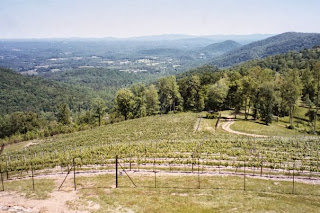
Closer to the Washington DC area, Bluemont Vineyard sits at 951 feet and affords a view of the landscape between the village of Bluemont (off route 7 in far western Loudoun County) and Reston/Tysons Corner. On a clear day you can see the skyscrapers of Reston Town Center and Tysons Corner, and with a pair of binoculars (or very good eyesight), you can see the tip of the Washington Monument. The winery is always buzzing with activity, but their multi decked tasting building has room for everyone. Bluemont is a working farm (you can visit the orchard side of the family on your way back down the steep hill). Rooster calls compete with the live bands every weekend. The wines are good "entry level" wines (many on the sweet side) for those just getting started with Virginia wine (and wine in general) exploration. Keeping with the farm theme, many wines are named after barnyard animals. With the exception of their fruit wines, named after the fruits themselves: The Strawberry, The Blackberry, and by far the most interesting wine here, The Peach, a 50/50 blend of Peach Wine and Rkatsiteli, a varietal from Georgia - Russia, not the state - that is gaining traction in Virginia.
View from Bluemont Vineyard, from the lower level of the winery:

One the most interesting wineries in the state, boasting a view so close to the mountains that you feel you can touch them, Chester Gap Cellars, near Front Royal, started as an experiment for the winery owners. Owner/winemaker Bernd Jung, a native of Germany, is a perfectionist who willfully admits that he's made some mistakes, as some of the most serious winemakers in the relatively difficult state (for wineries) of Virginia have confessed. His wines are higher in alcohol content than most in the state, some approaching 17% in alcohol content. Viognier is his specialty and depending on when you visit, you could be offered up to three different vintages and/or clone varieties of the signature Virginia white. The tasting room is rather bare bones, not much in the way of indoor seating, and due to the small size of the winery, no buses or limos are allowed. However this is a great "lesser known" spot and the view is breathtaking.
View from Chester Gap's deck:

As the case with wineries in the valleys, many other locations in Virginia offer fantastic views from the mountains and hilltops. Other favorites are listed below the three wineries spotlighted today:
Winery URLs:
Stone Mountain Vineyards
Bluemont Vineyard
Chester Gap Cellars
Other great views looking down:
Twin Oaks Tavern Winery
Willowcroft Farm Vineyards
Delaplane Cellars
Fox Meadow Winery
Wolf Gap Vineyards
Of course the wine is the primary draw at these locations. You will be hard pressed to find a Virginia winery that doesn't have at least one wine to your liking, unless you crave nothing but high alcohol Pinot Noirs prominently found in Sonoma, or sweet table wines commonly found in the front of grocery stores, usually with flip flops or slices of cake on the labels.
Last month, the blogmasters featured three wineries with views looking up (Pollak, King Family, and Wintergreen). This month we feature three locations with views looking down. A winery high in the mountains is not hard to find in the Commonwealth. Several exist along the I-66 corridor on the way to Front Royal. But the three that made the final cut are special for other reasons beyond the breathtaking views.
Great Views Looking Down
Stone Mountain Vineyards, northwest of Charlottesville, has a well-known slogan: "Taste the elevation." At 1700 feet above sea level, this location earns bragging rights as the highest vineyard in the state (and possibly the east coast). The road leading up to the winery is an event in itself. Watch for bears crossing! And when another car comes down the road, be prepared to pull over along cliffs that are not protected by barriers. Those suffering from vertigo may be a bit challenged, but the rewards are well worth it. The winery itself is an impressive building perched over the valley and resembles a ski chalet, on the outside and inside. White varietals are the star wines here, particularly their Chardonnay and Pinot Grigio (altitude suits these whites well). The Pinot Grigio is the traditional Italian dry style, with notes of honeydew melon and grass. The Rausse family (well known Virginia wine pioneer Gabriele and his son Peter) are the vineyard consultant and winemaker, respectively, guaranteeing the wines at Stone Mountain will be as special as the view and location.
Looking down from Stone Mountain's winery:

Closer to the Washington DC area, Bluemont Vineyard sits at 951 feet and affords a view of the landscape between the village of Bluemont (off route 7 in far western Loudoun County) and Reston/Tysons Corner. On a clear day you can see the skyscrapers of Reston Town Center and Tysons Corner, and with a pair of binoculars (or very good eyesight), you can see the tip of the Washington Monument. The winery is always buzzing with activity, but their multi decked tasting building has room for everyone. Bluemont is a working farm (you can visit the orchard side of the family on your way back down the steep hill). Rooster calls compete with the live bands every weekend. The wines are good "entry level" wines (many on the sweet side) for those just getting started with Virginia wine (and wine in general) exploration. Keeping with the farm theme, many wines are named after barnyard animals. With the exception of their fruit wines, named after the fruits themselves: The Strawberry, The Blackberry, and by far the most interesting wine here, The Peach, a 50/50 blend of Peach Wine and Rkatsiteli, a varietal from Georgia - Russia, not the state - that is gaining traction in Virginia.
View from Bluemont Vineyard, from the lower level of the winery:

One the most interesting wineries in the state, boasting a view so close to the mountains that you feel you can touch them, Chester Gap Cellars, near Front Royal, started as an experiment for the winery owners. Owner/winemaker Bernd Jung, a native of Germany, is a perfectionist who willfully admits that he's made some mistakes, as some of the most serious winemakers in the relatively difficult state (for wineries) of Virginia have confessed. His wines are higher in alcohol content than most in the state, some approaching 17% in alcohol content. Viognier is his specialty and depending on when you visit, you could be offered up to three different vintages and/or clone varieties of the signature Virginia white. The tasting room is rather bare bones, not much in the way of indoor seating, and due to the small size of the winery, no buses or limos are allowed. However this is a great "lesser known" spot and the view is breathtaking.
View from Chester Gap's deck:

As the case with wineries in the valleys, many other locations in Virginia offer fantastic views from the mountains and hilltops. Other favorites are listed below the three wineries spotlighted today:
Winery URLs:
Stone Mountain Vineyards
Bluemont Vineyard
Chester Gap Cellars
Other great views looking down:
Twin Oaks Tavern Winery
Willowcroft Farm Vineyards
Delaplane Cellars
Fox Meadow Winery
Wolf Gap Vineyards
Tuesday, August 13, 2013
Three Great Views: Looking Up
Another blogger recently wrote "why do so many people carry on about the views at Virginia wineries? The wine alone should be a draw." That sounds a lot like the Notebook bloggers complaining about live music at the wineries. Who knows - this particular blogger may love the live band element. But the Notebook loves the serenity of some the settings at the Commonwealth's wineries. Particularly those wineries in the mountains.
It's always a tough call when we visit the mountain wineries - views looking down, or views looking up (that is, being on top of a mountain, or in a valley). Three wineries in each category fit the bill perfectly and this post will examine three favorites in the valley, looking up at the mountains.
And of course the wine IS a draw at these locations. You will be hard pressed to find a Virginia winery that doesn't have at least one wine to your liking, unless you crave nothing but high alcohol Pinot Noirs prominently found in Sonoma, or sweet table wines commonly found in the front of grocery stores, usually with flip flops or slices of cake on the labels.
Great Views Looking Up
Pollak Vineyards, located in the Afton region west of Charlottesville and south of Waynesboro, has been a favorite of the blogmasters since they opened in 2008. They feature consistently excellent wines, at good prices. Their tasting room is airy with vaulted ceilings and bustling every month, from the cold and gray of January to the sticky heat of August. The winery spotlights Chardonnay, Viognier, Cab Franc and Meritage, but every wine is a winner.
The property, like many in the state, is huge with ample space to move around - even if the winery is packed, you can find an isolated spot by walking a few yards. There is a large pond that you can imbibe by, and take in the view of the surrounding mountains from the valley. The trucks on I-64 can be heard faintly in the distance but they are not a distraction.
King Family Vineyards is an eight minute drive from Pollak, located off the U.S. highway leading to Crozet and Charlottesville. Well known in the state as being a pioneer in the industry (King Family is one of the original Monticello AVA wineries), and the only winery with regular polo matches. There is a sense of "Dallas" (the TV show, not the city) in this winery, from the ranch-style layout of the property to the local members of the upper crust who come to watch the polo matches. But that should in no way deter you from visiting. The wine here, like Pollak, is outstanding, particularly the Chardonnay, Merlot and Crosé, a creative play on the words "rosé" and the nearby village of Crozet. The Crosé is crafted from their excellent Merlot. David King is a leader in the local and statewide wine industry and is frequently found during the weekends in the tasting room.
View from King Family Vineyards:

Wintergreen Winery is about a 30 minute drive from King Family or Pollak - follow the highway south towards the village of Nellysford and the Wintergreen Resort. You may get a craving for great local craft beer after passing not one but three popular microbreweries (Blue Mountain, Wild Wolf, and Devils Backbone), but keep driving - you will be soon rewarded. Wintergreen recently built a new events pavilion but the tasting room is the same intimate and quaint one we've grown accustomed to. Located on the banks of the Rockfish river, Wintergreen is surrounded by majestic mountains and the sound of the babbling creek complete the serene atmosphere. The wines are delicious; another Monticello AVA winery that excels at Chardonnay, the Black Rock Reserve is a must-try and must-buy. They also offer a raspberry wine and an apple wine, if you've grown tired of grape wines by this time (and trying these will also prepare you for a visit to nearby Hill Top Berry Farm and Winery, a few minutes away).
Wintergreen Winery:

There are plenty of other wineries with valley views looking up to grand mountains--CrossKeys Vineyards near Harrisonburg, Flying Fox Winery, northeast of Wintergreen, and Doukenie Winery in Loudoun County are three other blogger favorites with unique views.
Winery URLs:
Pollak Vineyards
King Family Vineyards
Wintergreen Winery
Hill Top Berry Farm and Winery
CrossKeys Vineyards
Flying Fox Winery
Doukenie Winery
It's always a tough call when we visit the mountain wineries - views looking down, or views looking up (that is, being on top of a mountain, or in a valley). Three wineries in each category fit the bill perfectly and this post will examine three favorites in the valley, looking up at the mountains.
And of course the wine IS a draw at these locations. You will be hard pressed to find a Virginia winery that doesn't have at least one wine to your liking, unless you crave nothing but high alcohol Pinot Noirs prominently found in Sonoma, or sweet table wines commonly found in the front of grocery stores, usually with flip flops or slices of cake on the labels.
Great Views Looking Up
Pollak Vineyards, located in the Afton region west of Charlottesville and south of Waynesboro, has been a favorite of the blogmasters since they opened in 2008. They feature consistently excellent wines, at good prices. Their tasting room is airy with vaulted ceilings and bustling every month, from the cold and gray of January to the sticky heat of August. The winery spotlights Chardonnay, Viognier, Cab Franc and Meritage, but every wine is a winner.
The property, like many in the state, is huge with ample space to move around - even if the winery is packed, you can find an isolated spot by walking a few yards. There is a large pond that you can imbibe by, and take in the view of the surrounding mountains from the valley. The trucks on I-64 can be heard faintly in the distance but they are not a distraction.
King Family Vineyards is an eight minute drive from Pollak, located off the U.S. highway leading to Crozet and Charlottesville. Well known in the state as being a pioneer in the industry (King Family is one of the original Monticello AVA wineries), and the only winery with regular polo matches. There is a sense of "Dallas" (the TV show, not the city) in this winery, from the ranch-style layout of the property to the local members of the upper crust who come to watch the polo matches. But that should in no way deter you from visiting. The wine here, like Pollak, is outstanding, particularly the Chardonnay, Merlot and Crosé, a creative play on the words "rosé" and the nearby village of Crozet. The Crosé is crafted from their excellent Merlot. David King is a leader in the local and statewide wine industry and is frequently found during the weekends in the tasting room.
View from King Family Vineyards:

Wintergreen Winery is about a 30 minute drive from King Family or Pollak - follow the highway south towards the village of Nellysford and the Wintergreen Resort. You may get a craving for great local craft beer after passing not one but three popular microbreweries (Blue Mountain, Wild Wolf, and Devils Backbone), but keep driving - you will be soon rewarded. Wintergreen recently built a new events pavilion but the tasting room is the same intimate and quaint one we've grown accustomed to. Located on the banks of the Rockfish river, Wintergreen is surrounded by majestic mountains and the sound of the babbling creek complete the serene atmosphere. The wines are delicious; another Monticello AVA winery that excels at Chardonnay, the Black Rock Reserve is a must-try and must-buy. They also offer a raspberry wine and an apple wine, if you've grown tired of grape wines by this time (and trying these will also prepare you for a visit to nearby Hill Top Berry Farm and Winery, a few minutes away).
Wintergreen Winery:

There are plenty of other wineries with valley views looking up to grand mountains--CrossKeys Vineyards near Harrisonburg, Flying Fox Winery, northeast of Wintergreen, and Doukenie Winery in Loudoun County are three other blogger favorites with unique views.
Winery URLs:
Pollak Vineyards
King Family Vineyards
Wintergreen Winery
Hill Top Berry Farm and Winery
CrossKeys Vineyards
Flying Fox Winery
Doukenie Winery
Tuesday, July 23, 2013
VIDEOCLIP: Bluestone Vineyards
Deep in the Shenandoah Valley, near Harrisonburg, Bluestone Vineyards.
Enjoying vino on a hot summer day in 2011.
Enjoying vino on a hot summer day in 2011.
Wednesday, July 17, 2013
Down in the Valley: Part III
The Shenandoah Valley AVA is a nearly 100-mile long stretch that begins north of Winchester and ends south of Lexington. Earlier this summer, we spotlighted the northern tip (Winchester) and southern tip (Lexington) of this region of farms, Americana towns, villages, and soil nicely drained by rivers and creeks running through the AVA, including the world famous Shenandoah River. The final stop is near the geographic center of the AVA - the Staunton/Harrisonburg area. Four very different wineries are within a few minutes drive from both of the Valley cities (Staunton/Harrisonburg and Waynesboro actually make up a "microplex," and share an airport--Shenandoah Valley Regional--which has commercial flights offered by United and Frontier Airlines).
Both Harrisonburg, home of James Madison University, and Staunton, home of several liberal arts schools, offer unique downtowns with numerous specialty shops and restaurants. And both cities have abundant hotels, motels and B&Bs, so dropping anchor after a day of tasting should pose no problem. Best of all, the towns are easy to get around - you don't have to drive far to get to VAVINOLAND.
Beginning in Staunton, you don't have far to go to visit the first winery: Ox-Eye Winery is the only Virginia tasting room located in a downtown section of a city in the Commonwealth. A few yards away from the hip wharf area of Staunton (home of the weekend farmer's market, several restaurants, and a great wine store), the Kiers family decided to place their tasting room in an urban environment, instead of having "just another winery next to a vineyard" (their vineyards are about eight miles from town). The tasting room and backyard patio are so irresistible, you may not want to leave. They open at 10 AM during the weekend, so you can get an early start. Wines you're more likely to find in upstate New York are the star whites here: Gewürztraminer, Traminette, and Riesling (the higher altitude in this part of Virginia allows these varietals to thrive here). Their steel aged Chardonnay is delicious, and they're the first Virginia we've visited that offers Lemberger, a spicy red that would pair well with a juicy steak, in any season.
The tasting room at Ox-Eye:

The aforementioned patio in the back is a perfect way to start (or end) your day. The patio is literally at the base of a mountain, and when the clock tower peals every hour, the sound echoes throughout the picturesque town. Shut your eyes and you could be in France or Germany.
As difficult as it might be, wrap it up at Ox-Eye after a few glasses (or a bottle), and jump back in the car to head north, towards Bridgewater and Harrisonburg. Your second stop is Bluestone Vineyard, which opened its doors about two and a half years ago and is already a regional, and state-wide, favorite. Surrounded by cornfields as well as vineyards, Bluestone already has an admirable number of vintages for its young age. Traminette and pinot noir are offered here as well; the blogmasters are still amazed at how well some spots in the Commonwealth excel at wines more commonly found in other states. Probably their most popular wine is a table white named Beau, after their golden retriever. This wine, the dog, and the proximity of James Madison University (for 21+ old females) probably explains why this wine is so popular. A bit too sweet for us, but would work very well on a 100 degree day with spicy food. Our favorite wine here was their Quartz Hill Red, a delicious blend of Cabernet Franc and Chambourcin, with powerful notes of currant and pomegranate.
Bluestone Vineyard:

Bluestone Vineyard lies on the western side of the I-88 corridor near Harrisonburg. A quick jaunt to the eastern side of the Interstate (after stopping in downtown Harrisonburg for lunch), near the airport, lies CrossKeys Vineyards. An impressive Mediterranean-style building and courtyard with tables and umbrellas greets visitors. The tasting room, like Bluestone, is usually hopping - once again, proximity to a large state university town doesn't hurt. Yet another pinot noir (who needs Oregon and California?!) is the standout wine here. One thing pinot noir fans will notice (for better or worse, depending on your taste buds) is that Virginia pinots have little in common with west coast pinots, in both character and alcohol content. These pinots are more mineraly, not too far removed from the cab francs that are found in nearly every tasting room in the state. But like Virginia wine in general, they do grow on you. CrossKeys is more of a red wine spot (while Bluestone is more of a white wine destination); however they do have a fine oaked (not too oaked) chardonnay here, with soft notes of vanilla. A table white called "Joy" was created for the fans of sweeter wines (there is a red table called "Joy" as well, a Chambourcin with a mild sweetness).
CrossKeys Vineyards:

CrossKeys was built with parties and weddings in mind, as well as winemaking, and if there happens to be a large event occurring while you visit, you won't have far to drive to escape that. The final stop is northeast of Harrisonburg, near the town of Stanley (on business route 340 towards Luray). Wisteria Vineyard is about as pure Virginia as you can get, complete with wandering farm animals, a mountain creek on the property, and a sipping porch. The first thing we noticed was the "back to nature" vibe of the location; if a winery existed near Woodstock, New York, it would probably resemble Wisteria. The wine is special, too. One red that was new to us is "Carmine," which is popular in California and resembles a lighter Merlot. They're the only winery in Virginia that offers this varietal. They have a Merlot as well, and their star white is their Traminette. This spot is a little further away from Harrisonburg/Staunton, and could be recommended for your drive back to the DC area. But it is certainly worth a visit--and it's one of the few wineries in the state that would appeal to children (courtesy of the free grazing farm animals).
Wisteria Vineyard:

The Shenandoah Valley of Virginia is a unique AVA that offers varietals you simply don't find in other parts of the state. With three sections of the valley bursting with flavor, the hardest decision is which part of the valley to pick (north, south, or central valley).
URLS:
Ox-Eye Winery
Bluestone Vineyard
CrossKeys Vineyards
Wisteria Vineyard
Both Harrisonburg, home of James Madison University, and Staunton, home of several liberal arts schools, offer unique downtowns with numerous specialty shops and restaurants. And both cities have abundant hotels, motels and B&Bs, so dropping anchor after a day of tasting should pose no problem. Best of all, the towns are easy to get around - you don't have to drive far to get to VAVINOLAND.
Beginning in Staunton, you don't have far to go to visit the first winery: Ox-Eye Winery is the only Virginia tasting room located in a downtown section of a city in the Commonwealth. A few yards away from the hip wharf area of Staunton (home of the weekend farmer's market, several restaurants, and a great wine store), the Kiers family decided to place their tasting room in an urban environment, instead of having "just another winery next to a vineyard" (their vineyards are about eight miles from town). The tasting room and backyard patio are so irresistible, you may not want to leave. They open at 10 AM during the weekend, so you can get an early start. Wines you're more likely to find in upstate New York are the star whites here: Gewürztraminer, Traminette, and Riesling (the higher altitude in this part of Virginia allows these varietals to thrive here). Their steel aged Chardonnay is delicious, and they're the first Virginia we've visited that offers Lemberger, a spicy red that would pair well with a juicy steak, in any season.
The tasting room at Ox-Eye:

The aforementioned patio in the back is a perfect way to start (or end) your day. The patio is literally at the base of a mountain, and when the clock tower peals every hour, the sound echoes throughout the picturesque town. Shut your eyes and you could be in France or Germany.
As difficult as it might be, wrap it up at Ox-Eye after a few glasses (or a bottle), and jump back in the car to head north, towards Bridgewater and Harrisonburg. Your second stop is Bluestone Vineyard, which opened its doors about two and a half years ago and is already a regional, and state-wide, favorite. Surrounded by cornfields as well as vineyards, Bluestone already has an admirable number of vintages for its young age. Traminette and pinot noir are offered here as well; the blogmasters are still amazed at how well some spots in the Commonwealth excel at wines more commonly found in other states. Probably their most popular wine is a table white named Beau, after their golden retriever. This wine, the dog, and the proximity of James Madison University (for 21+ old females) probably explains why this wine is so popular. A bit too sweet for us, but would work very well on a 100 degree day with spicy food. Our favorite wine here was their Quartz Hill Red, a delicious blend of Cabernet Franc and Chambourcin, with powerful notes of currant and pomegranate.
Bluestone Vineyard:

Bluestone Vineyard lies on the western side of the I-88 corridor near Harrisonburg. A quick jaunt to the eastern side of the Interstate (after stopping in downtown Harrisonburg for lunch), near the airport, lies CrossKeys Vineyards. An impressive Mediterranean-style building and courtyard with tables and umbrellas greets visitors. The tasting room, like Bluestone, is usually hopping - once again, proximity to a large state university town doesn't hurt. Yet another pinot noir (who needs Oregon and California?!) is the standout wine here. One thing pinot noir fans will notice (for better or worse, depending on your taste buds) is that Virginia pinots have little in common with west coast pinots, in both character and alcohol content. These pinots are more mineraly, not too far removed from the cab francs that are found in nearly every tasting room in the state. But like Virginia wine in general, they do grow on you. CrossKeys is more of a red wine spot (while Bluestone is more of a white wine destination); however they do have a fine oaked (not too oaked) chardonnay here, with soft notes of vanilla. A table white called "Joy" was created for the fans of sweeter wines (there is a red table called "Joy" as well, a Chambourcin with a mild sweetness).
CrossKeys Vineyards:

CrossKeys was built with parties and weddings in mind, as well as winemaking, and if there happens to be a large event occurring while you visit, you won't have far to drive to escape that. The final stop is northeast of Harrisonburg, near the town of Stanley (on business route 340 towards Luray). Wisteria Vineyard is about as pure Virginia as you can get, complete with wandering farm animals, a mountain creek on the property, and a sipping porch. The first thing we noticed was the "back to nature" vibe of the location; if a winery existed near Woodstock, New York, it would probably resemble Wisteria. The wine is special, too. One red that was new to us is "Carmine," which is popular in California and resembles a lighter Merlot. They're the only winery in Virginia that offers this varietal. They have a Merlot as well, and their star white is their Traminette. This spot is a little further away from Harrisonburg/Staunton, and could be recommended for your drive back to the DC area. But it is certainly worth a visit--and it's one of the few wineries in the state that would appeal to children (courtesy of the free grazing farm animals).
Wisteria Vineyard:

The Shenandoah Valley of Virginia is a unique AVA that offers varietals you simply don't find in other parts of the state. With three sections of the valley bursting with flavor, the hardest decision is which part of the valley to pick (north, south, or central valley).
URLS:
Ox-Eye Winery
Bluestone Vineyard
CrossKeys Vineyards
Wisteria Vineyard
Monday, June 17, 2013
Down in the Valley: Part II
The Shenandoah Valley of Virginia is one of the Commonwealth’s AVAs (American Viticultural Areas), and it’s easy to taste why. The soil drainage from the creeks and rivers leading through the Blue Ridge Mountains (to the east) and the Alleghenies (to the west), suits wineries deep in the valley well, while others in the foothills leading up to the mountain chains benefit from higher elevations that allow for varietals not typically found in Virginia, like Pinot Noir and Riesling. Winchester-area wineries were featured in a previous blog. On the southern end of the valley lies Lexington.
Lexington (and its nearby sister town, Buena Vista), is home to several colleges and universities (including Washington & Lee and Virginia Military Institute), as well as one of the best wine stores in the state (Uncorked, in downtown Buena Vista). As the case with many small Virginia towns, Lexington is rich in history. Tour the Stonewall Jackson House in Lexington for a fascinating glimpse into the life of the Civil War figure.
Lexington is smaller than Staunton or Winchester, so you can walk from one end of the town to the other in an hour (maybe longer if you visit one of the many unique shops). The proximity of the Natural Bridge, as well as the junction of two major Interstates (81 and 64), make Lexington a very vibrant town, despite its small size.
And of course there are wineries – to the southwest, northwest, and right off the Interstate. Rockbridge Vineyard, named after the aforementioned Natural Bridge (which recently was posted “For Sale”), is located about 2 minutes from the I-81 off ramp north of Lexington, but seems like a million miles away. The tasting room is housed inside a large barn, which doubles as the winery’s events center. One of the oldest wineries in the state, Rockbridge has something for everyone – from bone dry (they are one of the few Virginia locations offering a Pinot Noir; the elevation here is suitable for Miles’ favorite wine); to semi-dry (the relatively unknown, at least for the Commonwealth, Vignoles, with its notes of kiwi and macadamia nuts); to sweet (and delicious when chilled)—Jeremiah’s Blush, perhaps their most popular wine (a blend of Concord—another grape not very common in Virginia, and Vidal Blanc).
Not far from Rockbridge (and reachable via local country roads, to minimize your time on the Interstate), Lexington Valley Vineyard specializes in Norton, one of the signature Virginia reds. It’s no surprise that the owners hail from Missouri, which surpasses Virginia in Norton winemaking. Even those who are lukewarm towards the eccentric Norton grape will find something to enjoy here. The varietals are more on the sweet side, which would be perfect for hot summer months: Traminette (semi-dry), Vidal Blanc, and a rare (for the state) Catawba, a musky version of Concord. Their rosé made from their Norton is incredible, slightly spicy to offset the semi-sweetness. This is a very intimate winery, and in fact is only open by appointment. But they are definitely worth a visit and the prices are incredibly good.
Southwest of Lexington, high in the Alleghenies, lies Blue Ridge Vineyard, another location with rustic appeal, rolling hills on all sides, and wines that are unique compared to the rest of the state. As the case with the other wineries featured, options are more on the sweet side of the scale. In fact we found the wines at these three locations had more in common with the Finger Lakes offerings than the Commonwealth. Blue Ridge offers Riesling, Traminette, Gewürztraminer, Pinot Noir and several sweet table wines. Despite our preference to dry wines, there’s something about the mountains and the valleys that cry out for off-dry and sweeter options. Blue Ridge, like Rockbridge, conducts its (very) informal tasting in an old barn, and there are acres upon acres of land to spread out. You are well rewarded with room to move about when you visit these harder-to-find VAVINO spots.
After your winery visits, Lexington offers a number of fine restaurants. And you can always catch a movie at the drive in theater on the highway leading to Natural Bridge.
Rockbridge Vineyard
Lexington Valley Vineyard
Blue Ridge Vineyard
Other wineries relatively close to Lexington:
Virginia Mountain Vineyards (near Fincastle, about 15 minutes from Blue Ridge Vineyard)
Barren Ridge Vineyards (between Staunton and Waynesboro)
Ox-Eye Vineyards (downtown Staunton)
Visit Rockbridge Vineyard now, via a videoclip:
Part III will take us to the middle of the valley: Harrisonburg/New Market
Lexington (and its nearby sister town, Buena Vista), is home to several colleges and universities (including Washington & Lee and Virginia Military Institute), as well as one of the best wine stores in the state (Uncorked, in downtown Buena Vista). As the case with many small Virginia towns, Lexington is rich in history. Tour the Stonewall Jackson House in Lexington for a fascinating glimpse into the life of the Civil War figure.
Lexington is smaller than Staunton or Winchester, so you can walk from one end of the town to the other in an hour (maybe longer if you visit one of the many unique shops). The proximity of the Natural Bridge, as well as the junction of two major Interstates (81 and 64), make Lexington a very vibrant town, despite its small size.
And of course there are wineries – to the southwest, northwest, and right off the Interstate. Rockbridge Vineyard, named after the aforementioned Natural Bridge (which recently was posted “For Sale”), is located about 2 minutes from the I-81 off ramp north of Lexington, but seems like a million miles away. The tasting room is housed inside a large barn, which doubles as the winery’s events center. One of the oldest wineries in the state, Rockbridge has something for everyone – from bone dry (they are one of the few Virginia locations offering a Pinot Noir; the elevation here is suitable for Miles’ favorite wine); to semi-dry (the relatively unknown, at least for the Commonwealth, Vignoles, with its notes of kiwi and macadamia nuts); to sweet (and delicious when chilled)—Jeremiah’s Blush, perhaps their most popular wine (a blend of Concord—another grape not very common in Virginia, and Vidal Blanc).
Not far from Rockbridge (and reachable via local country roads, to minimize your time on the Interstate), Lexington Valley Vineyard specializes in Norton, one of the signature Virginia reds. It’s no surprise that the owners hail from Missouri, which surpasses Virginia in Norton winemaking. Even those who are lukewarm towards the eccentric Norton grape will find something to enjoy here. The varietals are more on the sweet side, which would be perfect for hot summer months: Traminette (semi-dry), Vidal Blanc, and a rare (for the state) Catawba, a musky version of Concord. Their rosé made from their Norton is incredible, slightly spicy to offset the semi-sweetness. This is a very intimate winery, and in fact is only open by appointment. But they are definitely worth a visit and the prices are incredibly good.
Southwest of Lexington, high in the Alleghenies, lies Blue Ridge Vineyard, another location with rustic appeal, rolling hills on all sides, and wines that are unique compared to the rest of the state. As the case with the other wineries featured, options are more on the sweet side of the scale. In fact we found the wines at these three locations had more in common with the Finger Lakes offerings than the Commonwealth. Blue Ridge offers Riesling, Traminette, Gewürztraminer, Pinot Noir and several sweet table wines. Despite our preference to dry wines, there’s something about the mountains and the valleys that cry out for off-dry and sweeter options. Blue Ridge, like Rockbridge, conducts its (very) informal tasting in an old barn, and there are acres upon acres of land to spread out. You are well rewarded with room to move about when you visit these harder-to-find VAVINO spots.
After your winery visits, Lexington offers a number of fine restaurants. And you can always catch a movie at the drive in theater on the highway leading to Natural Bridge.
Rockbridge Vineyard
Lexington Valley Vineyard
Blue Ridge Vineyard
Other wineries relatively close to Lexington:
Virginia Mountain Vineyards (near Fincastle, about 15 minutes from Blue Ridge Vineyard)
Barren Ridge Vineyards (between Staunton and Waynesboro)
Ox-Eye Vineyards (downtown Staunton)
Visit Rockbridge Vineyard now, via a videoclip:
Part III will take us to the middle of the valley: Harrisonburg/New Market
Sunday, June 2, 2013
NEW WINERY SPOTLIGHT 2: KILAURWEN WINERY
After Arlington County, the smallest county (in geographical area) in the Commonwealth is Greene County, wedged between Orange County, Madison County, and Albemarle County, north of Charlottesville. For those familiar with the Virginia winery scene, Stone Mountain Vineyards, the highest vineyards and tasting room (1700 feet above sea level) in the state, is located in Greene County, offering a spectacular view of the east from the Blue Ridge mountains. Not far from Stone Mountain is a vineyard that's been growing grapes for Stone Mountain (and other nearby wineries) since 1994: Kilaurwen Winery.
The name sounds Celtic, but the winery is actually named after the three daughters of the owners (Kimberlee, Laura and Wendy). Open as a tasting room since 2012, the wines here are complex (the reds), fruit forward (the whites), and tasty; the winemaker has learned from the masters of the area, including Dennis Horton, Luca Paschina, and the late Chris Breiner of Stone Mountain. The tasting room, albeit rather sparse (the owners have been spending most of their free time tending to the grapes and maintaining their eye and soul-pleasing property that surrounds the tasting room), lends itself to intimate tastings with the husband and wife owners.
Cab Franc rules supreme here for the reds; currently Kilaurwen offers three: 2009 vintage and two 2010 (regular and reserve). Each are unique due to the growing years and the aging process. We preferred the regular 2010, bold but smooth and delicious, with notes of vanilla and cinammon. Whites were also well balanced; currently they offer an off-dry (nearly totally dry) Riesling and an award winning table white. Prices are perfect; not one bottle over $20, which unfortunately is becoming less common, even in the winery packed Monticello AVA.
There are no highway signs (yet), however with the help of a good map and/or GPS, the winery is an easy trek to or from Stone Mountain or Early Mountain Vineyards, the winery AOL mogul Steve Case took over from the Sweely family last year. Kilaurwen's property is vast; a path cuts through a dense patch of forest that leads up a hill to the vineyards, which are sloping, ensuring proper drainage. Currently no plans are in the works for live bands or weddings and events; that is music to the ears of anyone wanting a true Virginia wine getaway from noise and the stress that goes with noise.
Check out our short video and be sure to visit Kilaurwen Winery this summer, which will make for a rather surreal visit with the 17 year cicadas buzzing like an orchestra:
The name sounds Celtic, but the winery is actually named after the three daughters of the owners (Kimberlee, Laura and Wendy). Open as a tasting room since 2012, the wines here are complex (the reds), fruit forward (the whites), and tasty; the winemaker has learned from the masters of the area, including Dennis Horton, Luca Paschina, and the late Chris Breiner of Stone Mountain. The tasting room, albeit rather sparse (the owners have been spending most of their free time tending to the grapes and maintaining their eye and soul-pleasing property that surrounds the tasting room), lends itself to intimate tastings with the husband and wife owners.
Cab Franc rules supreme here for the reds; currently Kilaurwen offers three: 2009 vintage and two 2010 (regular and reserve). Each are unique due to the growing years and the aging process. We preferred the regular 2010, bold but smooth and delicious, with notes of vanilla and cinammon. Whites were also well balanced; currently they offer an off-dry (nearly totally dry) Riesling and an award winning table white. Prices are perfect; not one bottle over $20, which unfortunately is becoming less common, even in the winery packed Monticello AVA.
There are no highway signs (yet), however with the help of a good map and/or GPS, the winery is an easy trek to or from Stone Mountain or Early Mountain Vineyards, the winery AOL mogul Steve Case took over from the Sweely family last year. Kilaurwen's property is vast; a path cuts through a dense patch of forest that leads up a hill to the vineyards, which are sloping, ensuring proper drainage. Currently no plans are in the works for live bands or weddings and events; that is music to the ears of anyone wanting a true Virginia wine getaway from noise and the stress that goes with noise.
Check out our short video and be sure to visit Kilaurwen Winery this summer, which will make for a rather surreal visit with the 17 year cicadas buzzing like an orchestra:
Saturday, May 18, 2013
Down in the Valley: Part I
The Shenandoah Valley of Virginia is one of the Commonwealth’s AVAs (American Viticultural Areas), and it’s easy to taste why. The soil drainage from the creeks and rivers leading through the Blue Ridge Mountains (to the east) and the Alleghenies (to the west) suits wineries deep in the valley well, while others in the foothills leading up to the mountain chains benefit from higher elevations that allow for varietals not typically found in Virginia, like Pinot Noir and Riesling.
An easy drive from several states in addition to Virginia (West Virginia, Maryland and Pennsylvania), the Shenandoah Valley is 100 plus miles of incredible views, charming small towns, and farmland. You don’t have to drive very far from the Interstate that bisects the valley (81) to find a quiet utopia here; in fact one of the seven covered bridges in the state is so close to 81 that you can hear trucks in the distance, just far enough not to disturb your quiet piece of heaven.
There are three towns you can designate as your home base, on the north end, south end, and in the middle: Winchester (north), Lexington (south) and Harrisonburg (middle). All three towns have numerous hotels, motels, and B&Bs, not to mention interesting and historical downtown sections.
Winchester is home to Patsy Cline and a famous apple industry. A pedestrian-only outdoor mall resembles the larger one in Charlottesville, and is dotted with restaurants and cafés offering local flavor.
Wineries near Winchester:
Valerie Hill, featured in a previous blog, features a tasting room in a home built in 1807. Open since 2012, Valerie Hill is typical for the Shenandoah wineries – rolling landscape and birds calling in all directions. Standout wines here are their Viognier, Chardonnay, and a Chambourcin/Cab Sauv blend.
North Mountain Vineyards is a blogger favorite, and has a storybook feel to it, right down to their tasting room building. A large deck and countless picnic tables dot the property, one of the original wineries in the region. Our favorite wines here are the Claret (a Meritage-like blend of Cabernet Franc, Cabernet Sauvignon, and Petit Verdot), Chambourcin, and Apple Wine (this is not far from Winchester, after all).
Shenandoah Vineyards is the oldest winery in the Shenandoah Valley, and is located near Shenandoah Caverns. Their tour is one of the most informative in the state. Best bet wines here are their Chardonnay, Reserve Chambourcin, and Rebel Red, an off-dry they tout as the “red wine for white wine drinkers.”
Wolf Gap Vineyard is named after the Wolf Gap that straddles the Virginia and West Virginia line in the Allegheny mountains. “Wolfgap Willie” is the name adopted by the owner/winemaker, Willard Elledge. Wolfgap Willie is a pure Virginia gentleman who may even take you down to the barrels for a private tasting, if he’s not too busy. Some of our favorites here are the mainstays: Cab Franc, Chambourcin, and Chardonnay. He offered a dry Riesling several years ago, and we hope he has another great vintage of that harder-to-find (in Virginia) wine.
Not far from Wolf Gap is the vineyard whose owner helped Willie get involved in the winemaking craft, Cave Ridge. The tasting building was designed with ski chalet in mind, using woodstain instead of paint. Viognier is the star here: At least three different versions are offered, from stainless steel aged to oak aged. All are delicious and offer distinctively different notes on the palate. The favorite reds is their blend: The bold Fossil Hill Reserve (Cabernet Franc, Chambourcin, and Petit Verdot), as well as their “Red Silk” Cab Franc, which is perfectly named.
Other wineries relatively close to Winchester:
Glen Manor Vineyards (near Front Royal, off Skyline Drive)
Veramar Vineyard (directly off route 7)
North Mountain Winery:

Wolf Gap Vineyards:

Covered bridge near Toms Creek, VA:

Part II will take us down to Lexington……
An easy drive from several states in addition to Virginia (West Virginia, Maryland and Pennsylvania), the Shenandoah Valley is 100 plus miles of incredible views, charming small towns, and farmland. You don’t have to drive very far from the Interstate that bisects the valley (81) to find a quiet utopia here; in fact one of the seven covered bridges in the state is so close to 81 that you can hear trucks in the distance, just far enough not to disturb your quiet piece of heaven.
There are three towns you can designate as your home base, on the north end, south end, and in the middle: Winchester (north), Lexington (south) and Harrisonburg (middle). All three towns have numerous hotels, motels, and B&Bs, not to mention interesting and historical downtown sections.
Winchester is home to Patsy Cline and a famous apple industry. A pedestrian-only outdoor mall resembles the larger one in Charlottesville, and is dotted with restaurants and cafés offering local flavor.
Wineries near Winchester:
Valerie Hill, featured in a previous blog, features a tasting room in a home built in 1807. Open since 2012, Valerie Hill is typical for the Shenandoah wineries – rolling landscape and birds calling in all directions. Standout wines here are their Viognier, Chardonnay, and a Chambourcin/Cab Sauv blend.
North Mountain Vineyards is a blogger favorite, and has a storybook feel to it, right down to their tasting room building. A large deck and countless picnic tables dot the property, one of the original wineries in the region. Our favorite wines here are the Claret (a Meritage-like blend of Cabernet Franc, Cabernet Sauvignon, and Petit Verdot), Chambourcin, and Apple Wine (this is not far from Winchester, after all).
Shenandoah Vineyards is the oldest winery in the Shenandoah Valley, and is located near Shenandoah Caverns. Their tour is one of the most informative in the state. Best bet wines here are their Chardonnay, Reserve Chambourcin, and Rebel Red, an off-dry they tout as the “red wine for white wine drinkers.”
Wolf Gap Vineyard is named after the Wolf Gap that straddles the Virginia and West Virginia line in the Allegheny mountains. “Wolfgap Willie” is the name adopted by the owner/winemaker, Willard Elledge. Wolfgap Willie is a pure Virginia gentleman who may even take you down to the barrels for a private tasting, if he’s not too busy. Some of our favorites here are the mainstays: Cab Franc, Chambourcin, and Chardonnay. He offered a dry Riesling several years ago, and we hope he has another great vintage of that harder-to-find (in Virginia) wine.
Not far from Wolf Gap is the vineyard whose owner helped Willie get involved in the winemaking craft, Cave Ridge. The tasting building was designed with ski chalet in mind, using woodstain instead of paint. Viognier is the star here: At least three different versions are offered, from stainless steel aged to oak aged. All are delicious and offer distinctively different notes on the palate. The favorite reds is their blend: The bold Fossil Hill Reserve (Cabernet Franc, Chambourcin, and Petit Verdot), as well as their “Red Silk” Cab Franc, which is perfectly named.
Other wineries relatively close to Winchester:
Glen Manor Vineyards (near Front Royal, off Skyline Drive)
Veramar Vineyard (directly off route 7)
North Mountain Winery:

Wolf Gap Vineyards:
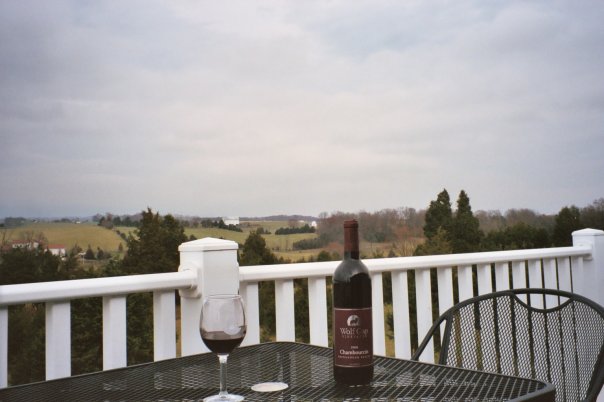
Covered bridge near Toms Creek, VA:

Part II will take us down to Lexington……
Subscribe to:
Posts (Atom)