As the blogmasters were DJs in a previous life, we met many winery owners in Virginia over the last ten years as we marketed our side business. So we thought now would be an appropriate time to mix tunes with grapes. This is the third entry in our analysis of what we believe are the best albums of the classic rock and roll era (generally considered to be the mid '60s to the mid '90s). We took a lot of time to carefully pair these albums with our favorite wines/wineries in the state.
If you want to get caught up on the previous lists, click here. And we will suggest a Virginia winery/wine to experience while listening to this album (bonus points for vinyl).
Part 3: 50 to 26
50. Making Movies/Dire Straits (1980)
After the disappointing sales and critical reception of their second album, Communiqué, Knopfler and company came back in full force with Making Movies, considered by many to be the band’s best album. “Tunnel of Love,” the kick off track, takes the listener on a rock and blues ride for over eight minutes; the song remains a Knopfler concert favorite to this day. The timelessness of “Romeo and Juliet” and “Skateaway” speak for themselves, and the band just rocks the hell out on “Solid Rock” and “Expresso Love.”
Suggested wine pairing: New Kent Winery White Merlot.
49. The Doors/Doors (1967)
The Doors took the summer of love on a hard-edged jazz and blues rock detour with their debut in 1967. “Break on Through” and “Light My Fire” remain quintessential Doors tracks to this day, and “The End” is still analyzed by "herb"-smoking English majors. But some of the best tracks are the lesser known gems: “Soul Kitchen,” with its incessant Manzarek organ and relentless Densmore drumming, and the two covers seemingly tailor made for Morrison: “Back Door Man” and “Alabama Song.”
Suggested wine pairing: Corcoran Vineyards Black Jack Chambourcin.
48. Crime of the Century/Supertramp (1974)
A year after Dark Side of the Moon, but five years before The Wall, prog rock favorites Supertramp crafted a Pink Floyd-esque concept album about mental illness leading to murder with Crime of the Century. After listening to the first track “School,” fans have to wonder if Roger Waters got some ideas for his 1979 Floyd magnum opus. Another cut, “Dreamer,” oddly became a Top 20 hit for the band as a live version in 1980, a year after Breakfast in America topped the charts. “If Everyone was Listening” is so atmospheric and beautiful, it’s hard to imagine the song is about a sociopath.
Suggested wine pairing: Otium Cellars Blaufränkisch.
47. Purple Rain/Prince and the Revolution (1984)
If you were alive in 1984, you could not escape this record. The movie may be considered ‘80s cheese by today’s standards, but the songs still sound great. And it’s quite hard to believe a silly ditty such as “Darling Nikki” was censored in this day and age of in-your-face obscenities found in hip hop and rap songs.
Suggested wine pairing: Horton Vineyards "Black Cat" Chardonnay.
46. Desperado/Eagles (1973)
The Eagles’ second album was a theme album about the American west. Amazingly, none of the songs from the album were big hits (not even the title track, one of the band’s most enduring tunes; the song was not released as a single). “Saturday Night” is one of the Eagles’ most underrated ballads, a Meisner, Henley, Frey, and Leadon collaboration as good as anything from their more successful albums which followed.
Suggested wine pairing: Desert Rose Ranch Winery Ole Moo Moo white blend.
45. Rumours/Fleetwood Mac (1977)
The album that turned rock and roll into a soap opera. Rumours was the soundtrack of the late ‘70s, with four singles reaching the Top Ten, and several more hitting the AOR (album-oriented rock) station airwaves. Exactly ten years later, the band released Tango in the Night, a semi-sequel, albeit less angry. And twenty years later in 1997, the Buckingham/Nicks incarnation of the Mac would embark on a world tour to support their album The Dance, and the songs which were “bitter” in 1977 became “bittersweet” in 1997, according to Lindsey Buckingham. You cannot be a fan of popular music and not have this CD or album on your shelf.
Suggested wine pairing: Cave Ridge Vineyards Syrah.
44. Summer Days (and Summer Nights)/Beach Boys (1965)
The best of the Beach Boys’ pre-Pet Sounds records (although some purists might make cases for Surfer Girl or Beach Boys Today!), the “sailboat record” has its share of cringe-inducing tracks (typical for the early Beach Boys records). Skip over tracks like “Salt Lake City” and “Amusement Parks USA,” and surround yourself in the sounds of “Help Me Rhonda” and “California Girls,” two of the Boys’ most famous songs, as well as lesser known Brian Wilson gems (“Girl Don’t Tell Me” and “You’re So Good to Me”), which paved the way for Pet Sounds a mere year later.
Suggested wine pairing: Cardamon Family Vineyards Emilia Rosé.
43. Thriller/Michael Jackson (1982)
This one needs no introduction, although some would argue 1979’s Off the Wall and even 1987’s Bad are better, more consistent records. Thriller was the right album at the right time, released in the infancy of MTV, and dominating both the airwaves and MTV (and “Friday Night Videos” for those unlucky “we don't have our MTV” households in the mid ‘80s). All but two tracks from the album hit the Top Ten, a record that has yet to be broken (sorry, One Direction….) An album that sits comfortably next to Rumours and Saturday Night Fever in the Rock and Roll Hall of Fame.
Suggested wine pairing: Wisdom Oak Winery North Garden Red.
42. Sheryl Crow/Sheryl Crow (1996)
This is the youngest album in our Top 100 list, which is a bit disheartening. Since the release of this album, the pop landscape has been littered with the music of alienation: Rap, teeny-bopper, derivative punk (Green Day, we're talking to you), and hip hop, and mediocre albums from stars who got their big break from a live talent show, not the old fashioned “take your album on tour and introduce the country and the world to it” way. Sheryl Crow’s second album is a mature sophomore effort, better than her scattershot first album Tuesday Night Music Club. Crow continues to make fine albums to this day, but none have surpassed the “every track is stunning” beauty of this album.
Suggested wine pairing: Maggie Malick Wine Caves Petit Manseng.
41. Tea for the Tillerman/Cat Stevens (1971)
The Greek-tinged Teaser and the Firecat may have sold more copies in the early ‘70s, but this is the essential Cat Stevens album. “Wild World,” “Where do the Children Play?,” “Father and Son,” and “Hard Headed Woman” still sound great today. Stevens, before he crossed into a more controversial world spotlight, was a tunesmith whose Nick Drake-esque delicate tunes resonated with a generation of music fans.
Suggested wine pairing: Doukenie Winery dry Riesling.
40. There Goes Rhymin' Simon/Paul Simon (1973)
Although many critics and Simon fans would put his 1986 comeback album Graceland in their top 100, “….Rhymin’ Simon” is our choice for Paul Simon’s best solo album. The album’s big singles (“Kodachrome,” banned in the UK for what they thought was promoting a commercial product, and “Loves Me Like a Rock”) still sound fresh today, and Simon sings with a level of honesty only hinted at in the Simon and Garfunkel albums. “Something So Right” is one of the best love songs of the rock era.
Suggested wine pairing: Miracle Valley Vineyards Sweet Michelle.
39. Goodbye Yellow Brick Road/Elton John (1973)
EJ’s 1973 double album is probably his most popular album (not including his Greatest Hits collections, which have actually sold more copies). He and Bernie Taupin conjured up a trick bag of graceful pop songs, epic seven minute tracks which remain concert staples (“Funeral For a Friend/Love Lies Bleeding),” tribute tunes (the immortal “Candle in the Wind”), balls out Who-like rockers (“Saturday Night’s Alright for Fighting”), and even a few reggae tunes. Not EJ’s best album according the Notebook (read on), but a worthy addition to every music library.
Suggested wine pairing: Ox Eye Vineyards Shy Ox blush.
38. Dark Side of the Moon/Pink Floyd (1973)
The quintessential Floyd album, according to most casual listeners (although a few other Floyd albums ranked higher on the Notebook's list). This album has become mystical in its reputation, and although we’ve all heard the songs so many times, the music still sucks us in from the very first heartbeat. The enchanting flow of the album, the lava lamp-invoking sound effects, the "Wizard of Oz" connection—there is a reason this album spent over 15 years on the Billboard Album Chart.
Suggested wine pairing: Hidden Brook Winery Cabernet Sauvignon.
37. A Space in Time/Ten Years After (1971)
When lead singer and guitarist Alvin Lee passed away in 2013, a new generation of music fanatics sought out his work with his old band, Ten Years After. A Space in Time is the band’s masterpiece, containing not only their most recognized song (“I’d Love to Change the World,” with lyrics more timely now than they were in 1971), but blues rocker jams on par with the likes of the Allman Brothers and Traffic, David Bowie-esque glam rock, and Yes/ELP prog rock.
Suggested wine pairing: Vineyards at Lost Creek Tranquility Rosé.
36. Stealers Wheel/Stealers Wheel (1972)
“Joe Egan and Gerry Rafferty were a duo known as Stealers Wheel...When they recorded this Dylanesque, pop, bubble-gum favorite...from April of 1973 that reached up to number five...as K-BILLY's ‘Super Sounds of the '70s’ continues.” And, Steven Wright, the rest of the album is not too bad either. A masterpiece, in fact, full of meticulously arranged Beatlesque/Badfinger (not really “bubble gum”) tunes, some of which are downright bizarre (“José,” which was the B side to the “Stuck in the Middle with You” single). A forerunner to Scottish pop ranging from Al Stewart to Bay City Rollers, not to mention the solo career of the late, great Gerry Rafferty, which peaked in 1978 with his album City to City and the single “Baker Street.”
Suggested wine pairing: Fincastle Vineyard Chardonnay.
35. Born in the U.S.A./Bruce Springsteen (1984)
The Boss’s second of three appearances on our “Hot 100.” This was his classic of the 1980s, although the moodier side of the Notebook occasionally prefers the 1982 acoustic classic Nebraska. Coming after the double, extremely uneven 1980 album The River and Nebraska, Bruce focused on creating a damn near perfect pop album, with six songs per side, and no songs over five minutes long. The Reagan Era-weary American music fans were ready for the Boss, and sent a record-breaking seven singles from this album into the Billboard Top Ten. The tunes spoke to the working class more than any Bruce album before it. Bruce at his peak; even the B-side to the first single, “Dancing in the Dark,” received major airplay….although sadly “Pink Cadillac” does not appear on the recent remaster of this great album.
Suggested wine pairing: King Family Vineyards Cabernet Franc.
34.Brothers in Arms/Dire Straits (1985)
Mark Knopfler and company took the experimental, jazz-based tone of their previous album, 1982’s overlooked Love Over Gold, and merged it with the radio-friendly sensibilities of 1980’s Making Movies and their 1978 debut album. The result was an unexpected world-wide smash, fueled by the catchy single (and accompanying groundbreaking music video), “Money for Nothing.” The rest of the album did not receive the constant exposure of “Money for Nothing,” which leaves those unfamiliar with the other songs in for a real treat. From “So Far Away” to “Ride Across the River,” the album simply transports you as the best rock albums do.
Suggested wine pairing: Blue Valley Vineyard Celebration red blend.
33. Modern Times/Al Stewart (1975)
While 1976’s Year of the Cat is the album Stewart is most remembered for, the album that preceded that is even better, filled with catchy hooks and bitter lyrics which are masked by Stewart and producer Alan Parsons’ lush production. “Carol” was a minor hit that paved the way for his two Top Ten singles in the latter part of the decade (“Year of the Cat” and “Time Passages”). Sensitive male lyrics don’t get any simpler than “Not the One”: “And you're not the one she's thinking of. And you're not the one she really wants. Just a point along the line....she's leaving from.” We’re not exactly sure what he’s talking about in the Jerry Garcia-esque “Apple Cider Re-Constitution,” but we believe the album makes a fine pairing with…….Cobbler Mountain Cellars Hard Apple Cider.
32. All Things Must Pass/George Harrison (1970)
As far as the solo Fabs go, Paul and John both had contenders for our list (Paul’s Band on the Run and John’s Imagine), but the solo Beatle album we continually reach for remains All Things Must Pass, George’s ambitious (originally released on three albums) collection of songs that were rejected by McCartney and Lennon for the later Beatles albums. Nevermind the “He’s So Fine”-soundalike accusations (and lawsuit) behind “My Sweet Lord;” the song will be remembered years from now when “He’s So Fine” is swept from the conscience of those who actually remember it on the radio. The rest of the album is wonderful and timeless as well.
Suggested wine pairing: Winery 32 Merlot.
31. Hotel California/Eagles (1976)
The album that nearly every rock music fan possess, the zenith of the Eagles’ popularity (although truth to be told, their popularity has never waned; their first Greatest Hits collection recently knocked Michael Jackson’s Thriller off the top of the “Best Selling Albums of All Time” list). A loose concept album about the dangers of the southern California lifestyle in the mid ‘70s, the album is almost Beatles-esque in its mystic, complete with an urban legend about the “devil worship party” on the cover.
Suggested wine pairing: West Wind Farm Winery Galena Creek red blend (not quite "pink champagne on ice," but our favorite wine from this beautiful location).
30. Sunflower/Beach Boys (1970)
During the not-so-love era between 1969 and 1972, the mellow, laid back, “love one another, and love the environment” vibes of the Beach Boys didn’t quite fit in with the times. The maestro of the band, Brian Wilson, confined himself to his bed, for months on end, grappling with a myriad of addictions and mental health issues. So it’s amazing the band pulled off this beguiling, masterful, wholly unappreciated gem; some music critics put it at the same level with Pet Sounds. Download the pop ear candy love song “Our Sweet Love,” or Dennis Wilson’s jazz-tinged “Slip On Through,” or Mike Love’s psychedelic wonder “All I Wanna Do” for a few tastes.
Suggested wine pairing: Crushed Cellars Vidal Blanc.
29. 461 Ocean Boulevard/Eric Clapton (1974)
Southern Florida comes shining through on Clapton’s magnificent album, undisputedly his best solo record. From the best known tracks, “I Shot the Sheriff” and “Let it Grow,” to the lesser known tracks like “Please be with Me” and “Give Me Strength,” this album truly soothes the soul.
Suggested wine pairing: Shenandoah Vineyards Founder's Reserve Chambourcin.
28. In Through the Out Door/Led Zeppelin (1979)
Led Zepp’s first appearance on our list is their “John Paul Jones album." Jimmy Page’s searing guitar dominated their previous album, 1976’s Presence, but for In Through the Out Door, Jones’ electric keyboards took center stage, which seemed appropriate for the disco era. The 10-minute plus track that opens side 2, “Carouselambra,” merges the psychedelia of their earlier albums with late 1970s Studio 54. “Fool in the Rain,” “In the Evening,” and “All My Love” are worthy classics in the same camp with “Stairway to Heaven,” “Ramble On,” “D’yer Maker,” and so on and so forth. And after tackling James Brown on Houses of the Holy, the band mimics Elvis Presley wonderfully on “Hot Dog.” The most fun Led Zepp had in the studio for sure.
Suggested wine pairing: Granite Heights Winery End of the Road red blend.
27. Electric Warrior/T. Rex (1971)
T. Rex (and arguably Lou Reed’s Transformer, a sister record for Electric Warrior in many ways) defined the glitter/glam movement in many ways, while a former mime from England (or Mars, perhaps) was continuing on his mystical interstellar odyssey (more on him later). Every song on this album still sounds "hell yeah!" and puts you in the mood for partying…..”Get it On” and “Jeepster,” of course, but don’t forget “Cosmic Dancer,” “Mambo Sun,” “Rip Off,” “The Motivator…” The whole damn thing.
Suggested wine pairing: Pearmund Cellars Viognier.
26. Innervisions/Stevie Wonder (1973)
Stevie Wonder was on an unprecedented creative roll between 1972 and 1976….even the Beatles couldn’t lay claim to the number of Grammys collected by Wonder during this period. Innervisions is the best album in a streak of great albums (Music of My Mind to Songs in the Key of Life). Urban issues, social issues, race issues, economic issues, love issues, death issues, and even a pie in the face to the Commander in Chief of the time…..it’s hard to believe, hearing this album now, that Berry Gordy initially wanted nothing to do with the album.
Suggested wine pairing: Potomac Point Winery Abbinato red blend.
Click The Big Ones....(the Top 25)..................

Saturday, January 2, 2016


Monday, December 28, 2015
In Praise of Wine Clubs
As the Notebook "wines" down another year, we thought a shout-out to Virginia's wine clubs was in order. We're here to plug the three wine clubs we belong to (alas, our respective day job salaries do not allow for more than three). But we are very much interested in feedback from other VAVINO fans and their wine club experiences.
Frequent visitors to Virginia wineries should pick at least 1 or 2 winery clubs to join. Typically, one receives free tastings (for up to 2, 3, or even 4 people), "members only" bottle releases, invitations to members' only events, and many other perks. The price schedules of the wine clubs vary from winery to winery, but the "Joining Fee" that so many wineries in the state required once upon a time seems to be a thing of the past, as the number of wineries in Virginia grows.
Pick a winery(s) near your home, for obvious reasons. Although most wine clubs in the state will ship your order (presuming you're a Virginia resident), driving to the winery to pick up your orders is cheaper and gives you an excuse to visit, even during the off-months (January through March). Plus you get those free wine tastings and the VIP treatment.
Here are the three current wine clubs the Notebook are members of:
Fox Meadow Winery "The Friends of Foxes":
This was the first wine club we joined in the state, way back in 2007 (a long time ago, in Virginia winery terms). Back then, most Virginia wineries had a "Joining Fee," which required a payment up front to join the club. With the number of competitors in the Virginia wine industry now, these joining fees seem to be a thing of the past, although Fox Meadow still mentions their "Initiation Fee" on their website. Fox Meadow Winery is a perfect spot for a "daycation;" an easy drive from the DC area (just be sure to leave your home before 11 AM during the busy wine hopping months, April through November), but far enough away (and deep in the mountains) to feel like you're really getting away from it all.
What you get:
-Two bottles of hand-picked vintages (not a bum note in the winery) every two months.
-Free tastings for two people.
-Special "library tastings" for you and your guest (and sometimes all of the visitors who are tasting at the bar when you are tasting, making you a wine hero for the afternoon).
-Invitations to special members only events, such as the Summer Solstice party, where the winery is open for members only until 9:00 PM.
-15% discount on all bottles and 20% discount on cases.
-Use of the Members Only wood stove room, which adjoins the main tasting room.
-Members can bring their own food into the winery (although we usually end up getting their Amish-made cheeses sold in the tasting room).
Willowcroft Winery "Press-tige" Wine Club:
Willowcroft is closer to DC than Fox Meadow (about 10 minutes south of Leesburg), which makes Willowcroft an easy getaway for an impromptu winery visit. The winery is located on a peak of the Blue Ridge foothills, and affords a western view of the Loudoun Valley (on a clear day, you can see Bluemont Winery on the other side of the valley). The tasting room is the epitome of rustic, inside a historic barn. The loft on the second floor of the barn is a recent upgrade and allows Willowcroft to be enjoyed in all seasons, versus just the spring, summer and fall months.
What you get:
-Two bottles of hand-picked wine every two months, with the option to swap a selected bottle for another one (regardless of the price). This is a particularly nice feature as Willowcroft offers many different wine styles, including a few in the off-dry and off-sweet category (which is not the Notebook's favorite style of wine).
-Complimentary tastings for two people, or two free glasses of wine, per visit. The tastings are very generous and usually include more than the typical allotment of wines.
-Invitations to special members-only evening events held February through December.
-15% discount on all bottles and 20% discount on cases.
-Exclusive reserving rights for the barn loft, if you plan to bring a group of wine lovers to Willowcroft.
North Gate Vineyard Trellis Club:
North Gate Vineyard is the youngest of the three wineries discussed in this post. Located in western Loudoun County, between Purcellville and Hillsboro, the eco-friendly winery offers a relaxing patio facing a pine forest, a wood burning fireplace (which shares a chimney with the gas fireplace inside the tasting room), weekend entertainment, and unique wines. The tastings may be paired with hand-made chocolates for an additional fee. This wine club is ideal for those who can't make it out to the Virginia wineries as often as they'd like, due to their quarterly wine release schedule.
What you get:
-3 bottles of wine every 3 months, chosen by the winemakers (although, as the case with Willowcroft, members can swap out a bottle for a different varietal if they care to).
-Free tastings for two people per visit.
-Once per quarter, a complimentary group tasting for the member and up to three guests.
-15% discount on all bottles and 20% discount on cases.
-Invitations to members-only events, such as release parties held in the wine cellar.
-Advanced access to first release of certain wines, specialty club wines, unique reserve wines, and the ability to purchase limited quantity wines.
We would love to hear from other Virginia winery club members, although we could stretch our wallets even more if some of the other wine clubs sound just too good to pass up.
Cheers!
Friday, December 11, 2015
MUSIC AND WINE TIME, PART II
As the blogmasters were DJs in a previous life, we met many winery owners in Virginia over the last ten years as we marketed our side business. So we thought now would be an appropriate time to mix tunes with grapes. This is part 2 of our analysis of what we believe are the best albums of the classic rock and roll era (generally considered to be the mid '60s to the mid '90s). If you want to get caught up on 100 through 76, click here. And we will suggest a Virginia winery/wine to experience while listening to this album (bonus points for vinyl). The matches have been carefully selected.
Part 2: 75 to 51
75. Gaucho/Steely Dan (1980)
Gaucho, the final album in Steely Dan's classic period (1973 to 1980), was over three years in the making, quite a change from the early days of The Dan, when they put an album out every year between 1972 and 1977. Perfectionist Dan took center stage, which remains the case for Donald Fagen and Walter Becker and their solo efforts that would follow. This album also took the longest to remaster when the Dan’s 1972 through 1980 output were remastered on CD in the late 1990s. The craftsmanship shows on every track, particularly the three hits (“Hey Nineteen;” only the Dan could get away with a chorus in a Top Ten single that mentions a certain herb and a brand of tequila; “Babylon Sisters;” and “Time Out of Mind,” featuring a zesty guitar solo from fellow master of bitter lyrics, Mark Knopfler).
Suggested wine pairing: Sunset Hills Vineyard (which as of print date does not offer a cherry wine or kirschwasser, both mentioned prominently on this album…..) Rosé.
74. Silk Degrees/Boz Scaggs (1976)
"Razz" (a mixture of rock and jazz) found its roots in the music of mid 1970s Steely Dan, as well as the mid-decade offerings of the Doobie Brothers, James Taylor, Carly Simon, Toto, Chicago, and Boz Scaggs. This genre is also known as "Yacht Rock," thanks to a series of hilarious YouTube videos. Silk Degrees, a magnificently-arranged album, stayed in the Top 100 Album chart for over two years (the last single from the album, “Lido Shuffle,” was released nearly a full year after the album came out). The unabashed Philly Soul tribute album that preceded this album, Slow Dancer, nearly made the 100 as well. Crank this album and prepare to be transported.
Suggested music and wine pairing: Notaviva Vineyards Ottantotto Viognier.
73. Exodus/Bob Marley (1977)
If you must own one reggae record, and one Bob Marley record, it must be Exodus. Marley brought reggae into mainstream acceptance, and the classic tracks from this album still resonate today: “One Love,” “Three Little Birds,” “Jamming,” “Waiting in Vain,” “Natural Mystic.” The sound of his native island spills into the grooves; a remarkable feat seeing how the album was recorded in the UK.
Suggested wine pairing: Chatham Vineyards Late Harvest Red Dessert wine.
72. Volume I/Traveling Wilburys (1988)
The band and album that started as a gag turned into one of the most fun, best sounding, and most successful, albums of the late 1980s. The Wilburys were an alter-ego, a’la "Sgt. Pepper’s Lonely Hearts Club Band", for George Harrison, Bob Dylan, Jeff Lynne of ELO, Roy Orbison, Tom Petty and session percussionist Jim Keltner. The group originally came together to record a B-side to a George Harrison solo single from his 1987 album Cloud Nine. The magic came together, and Volume I was born. Sadly Orbison died shortly after the album’s release; his soaring vocals on “Not Alone Anymore” from this album top nearly everything on his last solo record, Mystery Girl. The surviving ‘Burys (plus George’s son Dhani) came back in 1990 with “Volume 3.” The lack of Volume 2 was part of the gag.
Suggested wine pairing: Cardinal Point Winery Quattro white.
71. The Wild, the Innocent and the E Street Shuffle/Bruce Springsteen (1973)
Greetings from Asbury Park, the Boss’s other album of 1973, usually receives more acclaim, as it introduced the world to this working class hero from the Garden State. But The Wild, the Innocent….. is wilder, more experimental, and set the stage for his marathon live shows (the album gave its name to Bruce’s band, after all). Epic rockers like “Kitty’s Back” and “Rosalita (Come Out Tonight)” quickly became show staples, and the album closer “New York Serenade” remains one of Bruce’s most achingly beautiful recordings.
Suggested wine pairing: Blenheim Vineyards Merlot.
70. Bryter Layter/Nick Drake (1970)
Nick Drake released only three major label records during his sadly short life; all made an impact on the introspective songwriters of the early ‘70s, particularly Elton John, whose two 1971 albums (Tumbleweed Connection and Madman Across the Water) were affectionate Drake tributes. The middle of his three legendary albums (the others being 1969’s Five Leaves Left and 1972’s Pink Moon), this one is his most accessible. The use of several of its songs in movies over the last 15 years, ranging from Serendipity to Garden State, is proof of this, and Drake’s timelessness.
Suggested wine pairing: The Hague Winery Chardonel.
69. Year of the Cat/Al Stewart (1976)
Abbey Road and Pink Floyd sound engineer Alan Parsons teamed up with Scottish songsmith Al Stewart for a series of ear-candy pop records in the mid to late ‘70s. Year of the Cat is the best-known and most commercially successful of these albums. The commercial success of this album can be attributed to the title cut, a 6-minute plus single which joins Gerry Rafferty’s “Baker Street” as the lush FM radio anthems of the late ‘70s. The rest of the album is just as elegantly crafted and enchanting as the single, particularly the minor hit “On the Border” and the Cat Stevens-like “Midas Shadow.” If you’re only familiar with Al Stewart from hearing “The Year of the Cat,” you are in for a treat.
Suggested wine pairing: Hiddencroft Vineyards Traminette
68. America/America (1972)
One of the most underrated debuts in rock history, this album and band is best-known for their Neil Young sound-alike tune “A Horse with No Name,” which replaced Neil’s “Heart of Gold” at number one in the Billboard Singles chart in the early spring of 1972. The trio was also inspired by the dueling guitar work of Young’s occasional collaborators Crosby, Stills and Nash (listen to the juicy interplay of the opening track, “Riverside,” and the vocals of “Children;” CSNY homages to the max). “Sand Man” was written as a statement against the Vietnam occupation, but has a new meaning in post 9/11-America. Their second album Homecoming improved on this sound and offered tighter tracks, but the ramshackle spirit of the first album makes it a worthy addition to the Top 100.
Suggested wine pairing: Bluemont Vineyard “The Pig” Norton.
67. Temple of Low Men/Crowded House (1988)
The second album from New Zealand’s answer to the Beatles was a darker, moodier work than their eponymous 1986 debut album. Ex Split Enz leader Neil Finn tackled romantic and political issues with this album, and much to Capitol Records’ dismay, no singles in the order of “Don’t Dream it’s Over” or “Something So Strong” (the two big hits from their first album) were to be found here. Instead, eccentric tracks such as punkish “Kill Eye” and the Richard Thompson collaboration “Sister Madly,” and two haunting ballads as singles, which barely dented the charts in late 1988: “Better Be Home Soon” and “Into Temptation.” Their second album was a sign of things to come with their ‘90s output (both as a group, and the Finn Brothers albums).
Suggested wine pairing: Grayhaven Winery Touriga.
66. Learning to Crawl/Pretenders (1984)
“Back on the Chain Gang” was a Top Ten single over a year before the album it was extracted from was released; Chrissie Hynde and company were grappling with the drug overdose deaths of two original members, and most of the remaining tracks from the albums were appropriately edgier and angry, despite the pop sheen of the third single from the album, “Show Me.” “Middle of the Road” and “Time the Avenger” are perfect New Wave/rock blends as anything from their more-acclaimed first album; Hynde reflects on the plight of the Midwest middle class and motherhood with semi-autobiographical tunes such like “My City Was Gone,” “Thumbelina,” and “Watching the Clothes;” and the last track is a holiday tune (“2000 Miles”) that is sweet but not cloying. God forbid Chrissie be cloying.
Suggested wine pairing: 8 Chains North Winery Furnace Mountain Red.
65. Brothers and Sisters/Allman Brothers Band (1973)
The amazing thing about the Allman Brothers’ breakthrough album is that it gives the listener a real feel for being at a live show (just as Bruce’s The Wild, the Innocent and the E Street Shuffle does), without surrendering its impeccable production sound. This is the Allmans album that every music fan must own (though some critics will say 1971’s At Fillmore East is their essential album). “Ramblin’ Man” and the 7-minute plus instrumental workout “Jessica” became FM radio standards for most of the ‘70s, and “Southbound” and “Pony Boy” are pure blues jams.
Suggested wine pairing: We have to give this one to Creeks Edge Winery, Merlot if only because one of their frequent live solo musician offers “Jessica” by the “Almond” Brothers on his playlist, which was typed out by his pre-teen daughter (she gets an “A” for effort).
64. Eldorado/Electric Light Orchestra (1974)
ELO started their winning streak of blissful Beatles-esque pop albums and singles with Eldorado. The closest thing Jeff Lynne and company did to a rock opera, the dream-like spirit of the album was nearly equaled with their later albums (particularly A New World Record, which came out two years later). The band made it abundantly clear with this record that they were obsessed with the Beatles; George Harrison must have approved and hired Lynne to produce his 1987 comeback album, Cloud Nine.
Suggested wine pairing: Vault Field Vineyards Vidal Blanc.
63. Beggars Banquet/Rolling Stones (1968)
The Stones gave up the LSD-inspired experimentation of their previous album (Their Satanic Majesties Request) for down and dirty rock and roll, the first in their string of landmark albums recorded at the height of their artistic career. Brian Jones, despite his rapidly deteriorating health (and state of mind), contributed arguably his finest work on the slide guitar masterpiece “No Expectations,” and their fascination with American blues is felt in nearly every track. More from the Glimmer Twins to come….
Suggested wine pairing: Blue Ridge Vineyard Big Bear Red.
62. Zenyatta Mondatta/The Police (1980)
The Police’s third album is timeless. While Ghost in the Machine and Synchronicity sold more copies in 1981 and 1983, both albums contain tracks that are horribly dated (or, in the case of “Mother,” just horrible). This is not the case with Zenyatta Mondatta. Sting’s writing matures, and lyrics to his songs are quoted by both other musicians and even politicians today. They didn’t surrender the punk-meets-reggae vibe of their first two albums; they simply put a radio-friendly sheen over it. And they were rewarded with their first two Top Ten tunes (“Don’t Stand So Close to Me” and “De Do Do Do De Da Da Da”).
Suggested wine pairing: Chester Gap Cellars Viognier Reserve.
61. Astral Weeks/Van Morrison (1968)
The album many people still call Van Morrison’s greatest recording, this one barely made a dent in the charts or on U.S. (and UK) radio when first released. Morrison’s improvisational style was groundbreaking at the time; he basically told his studio musicians to play whatever comes to mind. Honest and elegant, vivid and beautiful, with a touch of late '60s psychedelia.
Suggested wine pairing: Two Twisted Posts Winery Chardonnay.
60. Nilsson Schmilsson/Harry Nilsson (1971)
The most successful album in the resumé of the artist who was called “the four Beatles, all wrapped into one man.” Nilsson was a brilliant computer programmer in the mid '60s who was blessed with pristine vocal cords. His earlier albums were whimsical works of art which caught the attention of not only John, Paul, George and Ringo, but contemporaries like Brian Wilson and Randy Newman as well. Harry takes you on a ride with this album—a ride that is heartbreaking, joyous, painful, funny, and tragic. Just as he lived his too-short life.
Suggested wine pairing: Peaks of Otter Winery Vino Colada (put the vino in the coconut and drink it all up...)
59. Sail Away/Randy Newman (1972)
Speaking of Randy Newman….Harry Nilsson cut an entire album of Newman songs in 1970. Newman examines (and critiques) America as a whole with this record (he would zone in on the American South two years later with Good Old Boys). The title track sums his cynicism up: “In America you'll get food to eat…..Won't have to run through the jungle…..And scuff up your feet…..You'll just sing about Jesus and drink wine all day….It's great to be an American.” And those are just the opening lines – it gets more honest (painfully honest) from there. The title track opens the record, and for the next 40 minutes, we’re in NewmanWorld: Dancing bears, songs about sudden stardom, earnest religious songs, tributes to his father, not one but two somber songs dedicated to cities in Ohio, and “Political Science,” with lyrics that are more relevant now than they were in 1972.
Suggested wine pairing: Saudé Creek Vineyards Pamunkey Fall.
58. Kick/INXS (1987)
INXS enjoyed superstar success on the wave of this album, which spent two years in the Top 100 Album chart and spun off four Top Ten singles. “Need You Tonight,” “Devil Inside,” “New Sensation” and “Never Tear Us Apart” still sound fresh today, which can’t be said about all radio hits of the era. Michael Hutchence was a dynamic front man, and the whole band merged rock with horn-fueled swing. At the time, even Keith Richards claimed the band was one of the best on the planet. There will never be another band quite like them, despite their efforts to reinvent themselves post-Hutchence (who committed suicide in 1997).
Suggested wine pairing: Cross Keys Vineyards Joy Red.
57. Chicago VII/Chicago (1974)
Chicago suffered in their later incarnations from overproduced sheen and schmaltz, which nonetheless proved enormously successful on the radio. But the 1969 to 1974-era Chicago was their classic period, before Peter Cetera hijacked the band with his borderline cheese pop songs, some of which were good (“If You Leave Me Now”), and others not-so-good (the perennial wedding favorite “You’re the Inspiration”). Their seventh album lands in our top 100 because it is a perfect representation of their classic period. A double album where the vocals don’t come in until the third song on side 2, the band jams before settling into the Chicago vocals we’re accustomed to (“Life Saver,” “I’ve Been Searchin’ So Long,” “Call on Me,” “Song of the Evergreens” and “Wishing You Were Here,” featuring the Beach Boys on background vocals, being the key tracks). The album is an insanely fun listening experience.
Suggested wine pairing: Three Fox Vineyards Volpe Sangiovese.
56. Automatic for the People/R.E.M. (1992)
The college radio darlings turned a corner when they signed with Warner Brothers records in 1988. College bars and small venues became stadium shows. Their third record for the label was recorded while 1991's Out of Time was still in the upper tiers of the Album Chart. And those expecting “Losing My Religion” or “Shiny Happy People,” part two, were in for quite a shock. “Drive,” “Man on the Moon” and “Everybody Hurts” were unlike anything the band recorded before: Moody, distant, and not immediately accessible. The songs, and the album, have endured and are more popular now than anything from Out of Time, including arguably "Losing My Religion." While the middle section of the record runs out of steam a bit, they rebound in a major way with the final two tracks on the album (the beguiling “Nightswimming” and the soothing “Find the River”).
Suggested wine pairing: Stone Mountain Vineyards Bacon Hollow Sunset.
55. Comes a Time/Neil Young (1978)
As any music fan knows well by now, there are two sides to Neil Young. The Godfather of Grunge, who continually tests the sonic limits of guitar rock (even after his brain surgery in the mid ‘00s). And the softer, quieter, folksy Neil, which is where Comes a Time comfortably fits. With backing vocals from the late Nicolette Larson, this is as close to a pure country album as Neil ever cut. The original version of “Lotta Love” appears here (Larson would have her own hit with it a year later). And the title track is one that the Notebook played at countless weddings during our DJ days – a real treat for the new couples. Timeless.
Suggested wine pairing: Michael Shaps Wineworks Tannat.
54. Tupelo Honey/Van Morrison (1971)
Our favorite Van Morrison album, this one kicks off with one of his signature tunes, “Wild Night,” and then progresses into a folk/country album that set the tone for other artists, particularly Neil Young. The album’s centerpieces are two magnificent love songs, “You’re My Woman” and the title track, which are as good as anything from Astral Weeks and Moondance. Absolutely underrated.
Suggested wine pairing: Hunters Run Wine Barn Todds Red Dessert Wine.
53. Seventh Sojourn/Moody Blues (1972)
The Moody Blues boasted an incredible album output from 1967 to 1972. As the title indicates, this is their seventh offering during this period. Days of Future Passed or In Search of the Lost Chord usually get mentioned as their finest records, but we feel this was the pinnacle of the first chapter in the Moodies’ catalog. Justin Hayward, the romantic of the band, contributes “New Horizons” and “Land of Make Believe,” two enchanted pieces that became FM radio hits, and John Lodge, usually the heavier-sounding of the band’s leaders, offered two more Moody standards, “Isn’t Life Strange” and “I’m Just a Singer (in a Rock and Roll Band).” You really can’t go wrong with any Moody Blues album (even Octave), but this is their most uniformly great recording.
Suggested wine pairing: DuCard Vineyards Popham Run Red.
52. Still Crazy After All These Years/Paul Simon (1975)
Paul’s third solo album, a Grammy favorite the year it was released. While we’d rather forget the image of him singing the title track dressed as a turkey on “Saturday Night Live,” the album is arguably his most personal, his “relationship record.” Only Paul Simon could compose a love song about sharing a winter cold (“I Do it for Your Love”), or comparing the cycle of life to a baseball game (“Night Game”). “50 Ways to Leave Your Lover” is the track most people know from this album, with borderline-silly name dropping lyrics that do not speak for the poignancy and depth of the rest of the album.
Suggested wine pairing: Zephaniah Farm Vineyard Chambourcin.
51. The Lamb Lies Down on Broadway/Genesis (1974)
The last and finest of the Peter Gabriel-era Genesis albums, Lamb….is a double disk concept record that traces the life and times of a Puerto Rican refugee living in New York City, who gets sucked into the drug world. Gabriel’s lyrics can be oblique at times (so much that even his band mates were mystified about what was going on), but the band (particularly Gabriel, who was warming up for his solo career) takes the listener on quite a journey, as the best double albums can do. The first album (or CD) contains more radio-friendly material (the title cut, the cheerfully perverse “Counting Out Time,” and the engaging “Carpet Crawlers”). The second album sounds more like the soundtrack to an urban horror film, which was the whole point.
Suggested wine pairing: Winery at LaGrange (preferably heard in their low-ceiling basement tasting room for a real mind-blowing experience) Cuvee Blanc.
........click here for 50 through 26...............
Sunday, November 29, 2015
50 West Vineyards: The New Leaves of Grass
January 2015: The Notebook visits an unusual winery up a long gravel (and horrible pot hole-infested) driveway directly off route 50, about 3 miles east of Middleburg. Leaves of Grass Vineyards is the intriguing name, and their wines (grapes brought in from other vineyards around the Commonwealth) were good to excellent; the promise of another fine daycation spot in the stressful environment that is Northern Virginia. Their Cab Sauv, in particular, was delicious, bold and offering strong cedar and spearmint notes.
The tasting room was nestled inside a restored farm building, with inviting glass surrounding a third of the tasting room, which afforded views of the Piedmont foot hills. The owner/winemaker was initially not onsite the day we visited, so the gracious ladies behind the bar (neither of whom spoke English very well) took care of the tastings. We found out the family that opened the vineyard were from Russia, with the owner bringing over not only extended family members, but friends as well. The winery operation was going to be a life-changing affair.
Photos of Leaves of Grass Vineyards: Early 2015


The hosts were so eager to please, the tastings were larger than usual. When the owner finally arrived, he and his large (and friendly) German Shepard (appropriately named Hans) greeted us as well. The normally drab January afternoon turned into a wonderful occasion with fine wine; we both purchased several bottles.
Flash forward to November 2015: The Leaves of Grass sign off route 50 is replaced with a sign reading "50West Vineyards." We drive up the hill on the gravel road, pot holes now completely filled in. Mini Coopers adorn the parking lot (did we somehow beam ourselves to Cooper Vineyards near Mineral, known for great wine, a LEED-certified tasting room, and their annual Mini Cooper festival?) The Russian hosts are replaced with a friendly pourer wearing a Sunset Hills Vineyards shirt. Everything else about the location was as we remember it; the windows overlooking the hills, the outdoor patios, the abundance of sound-absorbing wood inside the tasting room, the absence of a live band (the latter being a major plus for us).
Although we didn't get the full story about what happened to Leaves of Grass and the previous owners, the data we did receive from both the pourer and Diane Canney (co-owner of Sunset Hills) was financial - a big issue for new Virginia winery owners. If adequate research is not done, several years in advance in many cases, the best intentions (bringing more fine wine to the state) could be met with at best disappointment and at worst, a total bankruptcy situation. We hope the latter did not fall upon the previous owners.
A nearby Mini Cooper dealership was having an event, which explained the numerous Mini Coopers in the parking lot. The tasting building at 50West is deceptive - it is much larger than its outdoor appearance would lead you to believe. The second floor was being occupied by the Mini Cooper folks, but the first floor and patios were open to others. The wines during our visit were all from Sunset Hills, which created no issues for us as their wine is fantastic. At some point during the day, blogger David reached into his jacket and pulled out two labels from Leaves of Grass, which were given to him during the January visit, since the friendly Russian hosts that day did not have a tasting sheet listing their wines. The labels were meant to remind the bloggers of their wine styles. If the state of Virginia ever opens a wine museum, these labels would make a nice contribution.
Sunset Hills plans to use 50West as a satellite tasting room and eventually, this location will have its own wine style and label. Sunset Hills has been a favorite of the Notebook since they opened in 2008. It will be nice to enjoy their wine in a less-crowded, less noisy atmosphere (as anyone who has visited Sunset Hills can agree about). A festive mood is great if you're entertaining friends, but sometimes you want a lower key afternoon.
If anyone has additional information on what happened to the owners of Leaves of Grass, please reply to let us know.
Sunday, November 22, 2015
New Tasting Rooms Arrive in Loudoun
The Notebook was surprised and pleased to encounter not one, not two, not three, but four new tasting rooms in “DC’s Wine Country” (Loudoun County) over the past few months (and there is fifth new tasting room opening soon.) These elegant new spaces prove that the popularity of the Virginia wine scene is no passing fad.
Breaux Vineyards:
Breaux has been a mainstay on the VAVINO scene for years, and despite their popularity (consistently rated as one of the state’s best wineries offering the finest wines), their tasting room was almost always crammed, and the wait for a tasting could sometimes take 20 minutes (the exception, of course, was if you visited on a Wednesday afternoon around 2 PM.) The owners blueprinted the new tasting building (and adjacent events building) several years ago. They wanted to make them perfect. And did they ever.
The tasting building is bright and airy, offering plenty of room to spread out, regardless of how busy they are. This is the way a tasting building should be; wood dominates in the tasting room, for maximum sound absorption. A host in the tasting room sends guests to spots at the tasting bar that are available, or about to become available.
New tasting building at Breaux:
Under construction (July 2014):

August 2015:


Another major improvement is the patio in the back, affording visitors with breathtaking views of the Blue Ridge foothills. And this patio is “21 and over” and “no dogs!” We love kids, we love dogs…but sometimes you want to escape them. For families with kids (or dogs), there are plenty of other options for you.

The décor tastefully incorporates the owners’ Louisiana Cajun heritage. With so many new wineries popping up all over the county (including one which opened a mere quarter mile from Breaux several years ago), it is refreshing to see an established winery take such measures to improve the experience for their guests. The original tasting room is still used for spillover and smaller group events.
Breaux has always been a long-time friend, and with these improvements, they will reclaim their spot as our go-to winery in northern Loudoun County for out-of-state guests interested in the best of what Virginia wine and wineries have to offer.
Cardamon Family Vineyards and Two Twisted Posts Winery:
These wineries (a stone’s throw away from each other along Harper’s Ferry Road) have only been open for a little over a year, and previously tastings were conducted in tents near their gravel parking lots, quite close to the main highway. We visited their new tasting buildings recently, and they’re both special, and definitely different from one another.
Cardamon’s tasting bar hugs one side of an intimate, living room-style tasting room, and the view of the foothills so close to the house makes one believe he’s in Wise County, not Loudoun County. It seemed as if the entire family was behind the tasting bar the afternoon we visited, and the family made you feel like you were sipping great wine among long-time friends. And as usual, Chuck's salsa and wine pairings were a treat.
Two Twisted Posts’ tasting room is a bit more industrial in feel than Cardamon's; think Sonoma County instead of Wise County. Their story is interesting—they won a Governor’s Cup for their slightly oaked, extremely delicious Chardonnay two years ago. However, they had not finished their tasting building yet, and in order to accept the Governor’s Cup, a requirement of the winery is to offer tastings to the general public. They set up their tent and complied. We loved this location from the minute we set foot and were greeted by owner Theresa Robertson, a charming and witty host who entertained us with stories about her family history and their new adventure.
Zephaniah Farm Vineyard:
Further south in Loudoun County, in the “Harmony Cluster,” lays another perennial Notebook favorite. Zephaniah still conducts their tastings inside their 19th Century house, as the sit-down intimacy of this experience is adored by many. However, a chalet-like tasting building was erected up the hill, with a spectacular view of the surrounding woods and meadows. The owners invite all guests to visit the tasting room and relax, either inside the wood-dominated building (constructed primarily for special events and weddings), or on the porch (appointed with rocking chairs, to give it a truly Southern feel). And this could be the only winery in the state with a swimming pool near the tasting building. Where the owners take Nestea (or maybe chardonnay) plunges after hot days of working in the vineyards?
The new tasting "chalet" at Zephaniah Farm Vineyard:


Finally, we were intrigued by the new circular building on the grounds of Fabbioli Cellars….we understand that their new tasting building will be opening soon. So expect a “Part 2” to this Notebook entry in the next few months.
Cheers!
Wednesday, October 14, 2015
MUSIC AND WINE TIME
Virginia Wine Notebook’s Top 100 Albums of All Time
As the blogmasters were DJs in a previous life, we met many winery owners in Virginia over the last ten years as we marketed our side business. So we thought now would be an appropriate time to mix tunes with grapes.
What are your top 100 albums? It’s a challenge for any music fanatic to list. We frequently read articles and watch programs on cable TV which count down the top 100 (or 500, or even 1000) Best Albums of the Rock Era. And usually, the same selections appear over and over, while some of our favorites are left off. So here is our opportunity to set the vinyl record straight. And suggest 100 favorite wines from 100 favorite Virginia wineries while we do it.
The album format is a relic in the age of iTunes, Pandora and satellite radio. And in our humble opinions, true music died in 1991, when Billboard Magazine changed the methodology it used to track the popular success of songs. This is around the same time AM and FM pop radio died. Music popularity was based on MTV rotation. Not DJ rotation.
These are the great albums that contain true music created by artists who got their breaks the old-fashioned way; that is to say, original, not overly slick compositions, containing melody and harmony, and created by and performed by artists who did not get their big break from a bad televised talent show (and we don't mean The Gong Show or Star Search.)
Here are the Notebook’s choices for the top 100 albums, xx years in the making. There will be a few glaring omissions for some (especially those who adore big band, jazz, punk and ‘90s grunge). The fact that the most recent album on our list is from 1996 pretty much sums it up. Great music, at least in our minds, has been dead for nearly 20 years. And if we sound like a couple of disgruntled dudes, we are when it comes to music. Although we are optimistic when many people under 30 are now collecting (almost obsessively collecting) vintage vinyl. A co-worker of David’s, 25 years old, has been treating his office’s corridor with Black Sabbath, The Eagles, Crosby Stills and Nash and Bob Seger...on vinyl. Maybe there is hope........
And we’ve suggested a bottle of Virginia wine to go with each album. And extra points to you if you play the album on a turntable (half a point for a CD), versus listening to the album via YouTube or some other streaming service.
The simple criteria here: These are works we still reach for. Jimi Hendrix, Johnny Cash, Elvis Presley and Nirvana—influential to be sure but we don’t find ourselves reaching for their CDs....
Part 1: 100 to 76
100. Who by Numbers /The Who (1975)
First things first…Who fanatics will be disappointed to read that this is the only Who album in the Top 100. Who’s next and Tommy? Overplayed and outdated, in our vinomusica opinions. The single “Squeeze Box” is still quirky and fun, the whole album remains fresh sounding, and is also a warm-up for Townshend’s solo career (he sings lead on several tracks, including the winery appropriate “However Much I Booze,” the sweet sounding but bitter “They Are All in Love,” and the beautiful ukulele number “Blue, Red and Grey.”) This is the album the Notebook reaches for the most...except, maybe, Quadrophenia...
Suggested wine pairing: Burnley Vineyards Rivanna White
99. Hawks/Hawks (1981)
Naming themselves “Hawks” (not “The Hawks”) sounds a bit like “Eagles” (which is actually the formal name of the more-famous band)….but their name is made up of the letters of the members’ last names. Listen to this album, currently not available on CD (legend has it the original masters were burned in a warehouse fire), and you’d swear they’re from the UK. The album smacks of solo McCartney, Badfinger, and the Kinks, in a very fine way. Only this band is from Iowa. The story goes, the band (members all devout ‘60s British invasion fanatics) played clubs all over Iowa in the late ‘70s, and on a whim, sent a cassette of material to Columbia Records. And then were signed to the label...without even showing up at the label’s office! Unfortunately, in the era of post-punk New Wave, skinny ties, and Valley Girls, the album went nowhere commercially, except in their native upper midwest (the band cut one more album before being dropped by the label). One listen and you will be hooked—guaranteed.
Suggested wine pairing: Flying Fox Vineyards Trio
98. Holland/Beach Boys (1973)
The Beach Boys’ albums following Pet Sounds (and the subsequent breakdown of Brian Wilson) were mainly unheralded in the U.S., and were quickly dismissed by even the diehard Beach Boys fans. Overseas, these albums and occasional singles were more successful, and today they are finally getting the recognition they deserve (the remastered CD and vinyl treatment, for starters). Holland spun off a minor hit single with “Sail On, Sailor,” which Elton John has called one of his favorite Beach Boys songs. The album is fluid from start to finish, and the side two opener “The Trader” is a Carl Wilson classic.
Suggested wine pairing: James River Cellars Hanover White
97. Fear of Music/Talking Heads (1979)
Arguably the best studio album by David Byrne and company, this one brims with New York industrial New Wave energy (“Cities,” “Life During Wartime,” “I Zimbra”), and the elegant “Heaven” has been covered by at least a hundred different artists, from Simply Red to kd lang to Eric Burdon.
Suggested wine pairing: First Colony Winery Vidal Blanc
96. Sweet Baby James/James Taylor (1970)
A tall, lanky, sensitive artist like James Taylor (who some even compared looks-wise to Jesus) would probably be deemed by women today as being “creepy,” but Taylor took the singer/songwriter mellowness of Simon and Garfunkel and fused it with the naked honesty of Bob Dylan. The result was a record that spoke to a generation of music fans. Heard today, it’s delicate as an early December snow and just as magical. And as he proves on the delta bluesy “Steamroller,” the guy can let his hair down and have fun too.
Suggested wine pairing: Narmada Winery Viognier
95. Tapestry/Carole King (1971)
Following in the footsteps of James Taylor came another album that was (and remains) adored by millions, particularly women, who adopted “I Feel the Earth Move” as their anthem for at least the first half of the ‘70s. The album is made up of newly penned King songs (most of which have become standards, like “It’s Too Late” and “So Far Away”), and covers of her own songs, which were introduced to the world by other artists (“Will You Love Me Tomorrow,” “You Make Me Feel Like A Natural Woman”). This one’s for you, Kate!
Suggested wine pairing: Marterella Winery Grace
94. Some Girls/Rolling Stones (1978)
The Stones’ New York album. If you listen carefully, you can even hear the hiss of cocaine caught in the grooves of this album. “Miss You” proved that even the rockers can disco out, and Rod Stewart, Kiss and the Electric Light Orchestra would soon churn out songs that joined “Miss You” amidst the strobe lights of Studio 54. The rest of the album is rude and raw, as only Mick and Keef can be….”When the Whip Comes Down,” “Shattered,” and the PC Alert title track. Radical Christian Televangelism gets the pie in the face treatment in “Far Away Eyes,” proving the Stones were not shy of political content: “I was driving home early Sunday morning through Bakersfield---Listening to Gospel music on the radio station---And the preacher said, ‘You know you always have the Lord by your side’. And I was so pleased to be informed of this that I ran twenty red lights in his honor. Thank you Jesus. Thank you Lord.”
Suggested wine pairing: Naked Mountain Petit Manseng
93. The Stranger/Billy Joel (1977)
The Piano Man’s commercial breakthrough, this album could almost be deemed an early greatest hits set. And the fact that it contains “Scenes from an Italian Restaurant” makes it a natural fit for a wine and winery based top 100 album list. The album has been criticized as being overly slick by fans of his earlier work, but mainstream acceptance was what BJ was going for. And he got it in spades. Despite the cut that sounds like a bad song from a Rocky sequel, The Stranger hits all chords.
Suggested (bottle of red, bottle of white, or how about a rosé tonight?): Gadino Cellars Sunset
92. Saturday Night Fever/soundtrack (1977)
This soundtrack and the Bee Gees were the recipients of the one of the biggest backlashes in pop music history. It took over ten years for listeners to publicly listen to, and admire, the album again. It remains the definitive classic of the disco era, and not just for the Bee Gees tracks on side 1.
Suggested wine pairing: Casanel Vineyards Cabernet Sauvignon
91. Transformer/Lou Reed (1972)
That late, great king of New York fringe music, this one is by far Reed’s masterpiece. He took a cue from David Bowie (who joins him on “Satellite of Love”) and crafted an album that surpasses Bowie’s own work in many ways. This is attributed to Reed’s deadpan voice and sardonic pen. And “Make Up” earns the distinction as being one of the funniest songs in rock history.
Suggested wine pairing: Old House Winery. Walk on the Wild Side with their Wicked Bottom Chambourcin (ask them about how the wine got its name).
90. Meddle/Pink Floyd (1971)
The first side contains some of the Floyd’s strongest guitar-work (“One of These Days,” “Fearless”). We’ll even give a pass to the silly ditty with the dog, “Seamus.” What makes the album a classic is side 2, the magnum opus “Echoes.” Think Pink, indeed.
Suggested wine pairing: Tarara Winery Chardonnay
89. Duke/Genesis (1980)
Duke was the pinnacle work of the Collins/Banks/Rutherford incarnation of Genesis, before Collins and his solo career somewhat sidetracked their next four albums with more radio-friendly material. This album blends the artistic rock, keyboard-based tendencies of Tony Banks, the underrated guitar work of Mike Rutherford, and the songwriting craft of Phil Collins perfectly. And “Duchess,” the stand-out track here, contains lyrics that predicted the rise of the Diva in pop music, three years before Madonna and 25 years before Lady Gaga.
Suggested wine pairing: Gray Ghost Vineyards Gewürztraminer
88. Let it Be/Beatles (1970)
The Fab Four’s first appearance on this list is their loosest record. Made up primarily of outtakes from the White Album sessions, with symphonic production added by Phil Spector (to the dismay of Paul and delight of the others, especially George), the album combines beautiful ballads like “Across the Universe” and the title track with John-dominated heavy blues/rock tunes. And John’s between-song banter still brings smiles to listeners after all these years.
Suggested wine pairing: Barboursville Vineyards Barbera Reserve
87. Bringing it All Back Home/Bob Dylan (1965)
The album that made his fans “boo.” The first side is heavy duty electric, a sound that influenced artists from the Beatles to Jimi Hendrix. The second side is the folksy acoustic numbers his fans adored. An undisputed masterpiece and the best of Dylan’s early records.
Suggested wine pairing: Linden Vineyards Claret
86. The Dream Weaver/Gary Wright (1976)
Gary Wright brought enchanting electric keyboard pop to the AM and FM airwaves in 1976 with “Dream Weaver” and “Love is Alive,” the number two singles from this album, but the rest of the record is stunningly fluid, incorporating the works of the two big Stevies: Wonder and Winwood. Wholly underappreciated — both the artist and the album.
Suggested wine pairing: Wolf Gap Winery Viognier-Traminette
85. In the Wake of the Flood/Grateful Dead (1973)
Although most wines we drink do not bear up to 30 years of aging, it seemed the legendary Grateful Dead became deeper & more complex in their sub rosa way every year from 1965 to 1995. However, you could have enjoyed them in any of their vintages to appreciate the many dimensions and joys they offered so many of us. "All the years combine, they melt into a dream."....begins a favorite from this album, "Stella Blue." But evanescence is a reality that any fine wine connoisseur will already understand. The album ends with the magum opus Let It Glow and we accept it as edict from on high: "That the work of his day measures more than the planting and growing - Let it grow Let grow, greatly yield.”
Suggested wine pairing: Sharp Rock Vineyards Old Rag Red
84. Good Old Boys/Randy Newman (1974)
Randy Newman is America’s critic in song. And on this album, he examines the American south, in a bold manner that hits the listener in the gut, and the funny bone, simultaneously (those only familiar with Newman from his Disney movie tunes will get a real taste of his acidic pen from the title track). A Louisianan, he retells the story of a New Orleans flood from 1927 that hit home in the aftermath of Hurricane Katrina, proving that history does indeed repeat. Especially in the United States. He’s also capable of achingly honest love songs, as “Marie” proves. A masterpiece.
Suggested wine pairing: Breaux Vineyards Chère Marie
83. Blonde on Blonde/Bob Dylan (1966)
The second of three Dylan classics on our list; this album is arguably more revered that any of his others, although the harmonica on the side 1 tracks comes off a bit too strong on the recently remastered CD (the harmonica makes our cats scramble out of the room when we play it). Still, the effect this album had on musicians like John Lennon, Jackson Browne, and Neil Young cannot be overstated.
Suggested wine pairing: Chateau Morrisette Star Dog
82. Rio/Duran Duran (1982)
The early ‘80s British new wave scene produced only a handful of great albums (The Human League’s Dare, Tears for Fears’ The Hurting, Naked Eyes, the Thompson Twins’ Side Kicks). Rio is the one that made the list. It was the album they made before they became MTV pretty boys, who put the emphasis on their looks and videos over their songs. These songs were written and recorded before the videos were realized. The hits are there, of course (“Hungry Like the Wolf,” the title track, “Save a Prayer”), but the album really kicks in gear with the non-hits, dreamy tracks like “Lonely in Your Nightmare” and “The Chauffer.”
Suggested wine pairing: Williamsburg Winery Viognier
81. The Visitors/ABBA (1981)
Their last studio album of original material, this is ABBA’s finest record, which further improved on the production value of their previous two albums, the excellent Voulez-Vous and Super Trouper. ABBA wasn’t exactly on most people’s minds in late 1981, which is why singles like “When All is Said and Done” and “Slipping Through my Fingers” flopped, but the maturity in engineering and lyrical content shows how far the band has come since “Honey Honey” and “Mamma Mia.” Their sound is also quite theatrical on this record, a sign of things to come.
Suggested wine pairing: North Mountain Vineyards Mountain Midnight
80. Voices/Hall and Oates (1980)
Two early ‘80s nuggets deserve a third. The duo was frustrated with the lukewarm critical and commercial success of their albums released since “Rich Girls” topped the charts in early 1977. On top of that, their label, RCA, was threatening to drop them (which had already happened to the duo when Atlantic dropped them in the early ‘70s). So with nothing to lose (except their contract), H&O threw the ball of wax into their 1980 record, inexplicably not caring about radio airplay and chart success. The first two singles from Voices, “How Does it Feel to be Back” and “Big Kids,” didn’t make much of a dent in the charts, but their reluctant release of a cover tune, the Righteous Brothers’ “You’ve Lost that Loving Feeling,” changed the tide. In a very big way. Then came two more singles from the album, “Kiss on My List” and the eternal favorite “You Make My Dreams.” Only to be followed by four more studio albums with RCA, which dominated the radio for the next five years.
Suggested wine pairing: Prince Michel Vineyards Rapidan River Dry Riesling
79. One of These Nights/Eagles (1975)
The Eagles wrote about Hall and Oates in their song “New Kid in Town.” But that’s from another Eagles record, one Hotel California, which we’ll get to later. One of These Nights was a transitional album for the SoCal band – moving from the country and western tinged vibe of their first three albums, to the Laurel Canyon darlings they became in the late ‘70s. And just to prove they were moving in a new direction, they opened the album with the title cut (one of their number one singles), which bordered disco with its tempo and Barry Gibb-like vocals. This was Bernie Leadon’s last album with the band; a founding member of the Eagles, he was responsible for the C&W flavor of their earlier albums. He bows out of the band gracefully with the beautiful ballad “I Wish You Peace,” which closes the album.
Suggested wine pairing: Mountain Cove Vineyards Tinto
78. Nothing Like the Sun/Sting (1987)
By far the best Sting solo album, the former Policeman infuriated many (fans and peers included) when he fired the session musicians from his first album (the “Blue Turtles” of the album’s title). But Sting was on another path for his second record, which traded in the pop/reggae sensibilities of his Police work and Dream of the Blue Turtles for more jazz-oriented introspection. Songs like “The Lazarus Heart,” “Be Still My Beating Heart” and “Fragile” are as personal as Sting ever wrote, and he still managed to be self-deprecating with “Englishman in New York” (which he retooled as “English Dude in New York” for his live shows in the U.S. in 1988).
Suggested wine pairing: Ox Eye Vineyards Lemberger
77. Back in the High Life/Steve Winwood (1986)
No Traffic albums made this list; as legendary as Winwood, Capaldi and company were, their albums are rooted deeply in the rock/blues format of the early ‘70s. This is not to say albums like John Barleycorn Must Die and Low Spark of High Heeled Boys are not classics; they are. But we simply don’t reach for them on a regular basis. Winwood’s solo breakthrough, on the other hand, is still fresh-sounding and fun, despite its slick mid ‘80s sheen. Contributions from Chaka Khan, James Taylor, and Joe Walsh injected Winwood’s previously quieter, Donald Fagen-esque material (“While You See a Chance,” “Arc of a Diver”) with soul, poignancy, and an edge, respectively. And “Higher Love” still gets people’s feet moving.
Suggested wine pairing: Ingleside Vineyards Virginia Brut
76. Excitable Boy/Warren Zevon (1978)
The late Warren Zevon had a cult following writing songs dripping with biting sarcasm that would make Steely Dan sound like John Denver in comparison. Best known for “Werewolves of London,” (a cut from this album), Excitable Boy is Zevon at his peak. The album is full of numbers with lyrics both hard-edged and cynical (“Lawyers, Guns, and Money”), quirky (“Night Time in the Switching Yard,” which offers a bonafide disco beat), and bizarre (the title track, with Linda Ronstadt and Jennifer Warnes singing in perfect harmony).
Suggested wine pairing: DelFosse Vineyards Malbec
..........75 through 51.............
50 through 26
25 through 1
Monday, September 14, 2015
A Tale of a Winery: Capitol Vineyards
Driving around the country roads that run parallel with and bisect Virginia state highway 55 in northern Virginia in late August (a state highway we've dubbed the "wine highway"), we decided to pay a visit to Capitol Vineyards, a spot that opened without much fanfare in spring 2011 (around the same time as nearby Cobbler Mountain Cellars).
Imagine our disappointment to see this once-promising place barren, with weed-choked vineyards, a deserted tasting cabin (which was a post office in a previous life and served as the main point of entry for the winery), and a sad-looking house near the back of the property. Clearly the location has closed, although their website and Facebook pages are still live (last Facebook entry last January), and Yelp does not list the location as being closed. If it was open, it sure didn't look it.
Capitol Vineyards began as an investment and experiment in 2009-2010 between several young adults who had jobs as interns and other positions on Capitol Hill (hence their winery name). The tasting room opened in spring 2011, with the release of several wines made from grapes from other vineyards (in Virginia as well as other states). The vineyards were freshly planted when we first visited, complete with the tubing:


The young lady who conducted the tour seemed a bit nervous but very friendly, and gave us a history of the property as well as their plans for the future: She and her other friends were going to convert the house in the back of the property (which nicely hugged the side of a mountain and was about as far away as you could get from civilization in Northern Virginia) into a bed and breakfast, and the location was going to host weddings, reunions and corporate events. We kicked back with a chilled bottle of one of their offerings, a nicely crisp Viognier, and enjoyed the natural scene (we were visited by not only a friendly tuxedo cat named Rex, but some fawn as well):

Since the Notebook's visit in spring 2011, we had been meaning to return, but were always mystified by the lack of state-issued highway grape cluster signs leading would-be visitors to their winery. Located off a narrow half paved/half gravel road in the Markham area of route 55, the place is a challenge to find, even with GPS. The winery opened around the same time as Cobbler Cellars, and as Cobbler grew in popularity, had their highway signs installed, and built their new tasting room, Capitol Vineyards was strangely quiet. We now know why.
The blogmasters had a long discussion about Capitol after seeing the state of the winery in late August 2015, and we'd be curious to hear from others who visited this location, particularly if anyone has information on what happened. Our speculation: Money ran out. The location was hard to find, their Facebook page wasn't very active, their wine was quite expensive, and their original ambition and enthusiasm may not have been enough to sustain them. That could have been the reason for the nervousness of the young lady who served us. We hate to see this happen to Virginia wineries, especially if it's a money issue and not a "the owner was a celebrity-obsessed arrogant asshole" (as was the case with Oasis) issue.
The state of Capitol Vineyards, as of August 2015:


Perhaps the soil was too tainted to grow grapes (which explains why another vineyard did not take them over). Perhaps the schedules of the investors were too harried (a fate that also befell Hume Vineyards, which also opened in 2011). 2011 cannot be designated a "cursed year," since Cobbler Mountain Cellars is doing so well. We wish the prior owners well and maybe some day, they'll take another shot at the winery business, maybe with slightly less ambitious (and costly) visions.
Imagine our disappointment to see this once-promising place barren, with weed-choked vineyards, a deserted tasting cabin (which was a post office in a previous life and served as the main point of entry for the winery), and a sad-looking house near the back of the property. Clearly the location has closed, although their website and Facebook pages are still live (last Facebook entry last January), and Yelp does not list the location as being closed. If it was open, it sure didn't look it.
Capitol Vineyards began as an investment and experiment in 2009-2010 between several young adults who had jobs as interns and other positions on Capitol Hill (hence their winery name). The tasting room opened in spring 2011, with the release of several wines made from grapes from other vineyards (in Virginia as well as other states). The vineyards were freshly planted when we first visited, complete with the tubing:

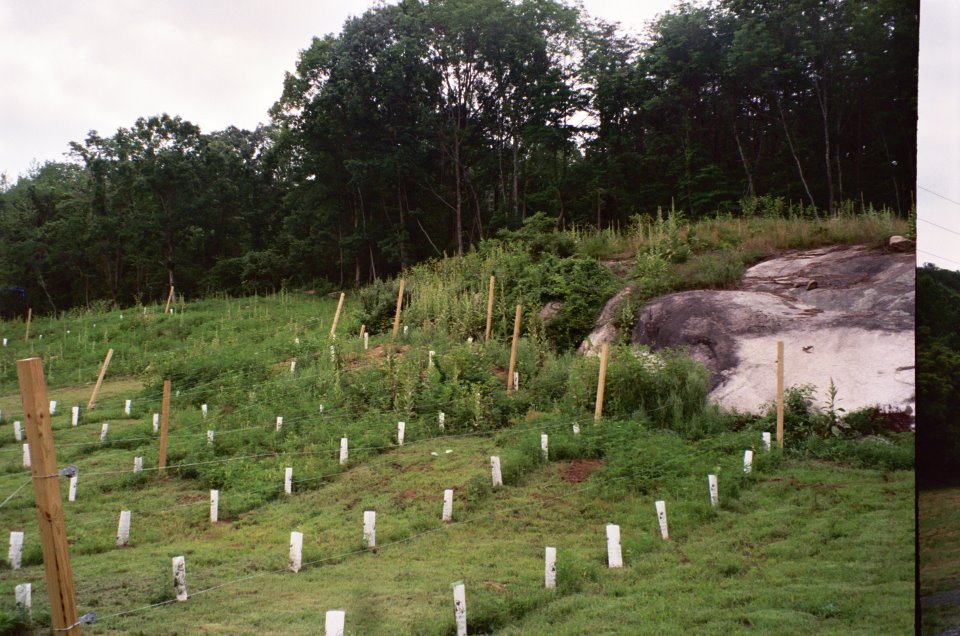
The young lady who conducted the tour seemed a bit nervous but very friendly, and gave us a history of the property as well as their plans for the future: She and her other friends were going to convert the house in the back of the property (which nicely hugged the side of a mountain and was about as far away as you could get from civilization in Northern Virginia) into a bed and breakfast, and the location was going to host weddings, reunions and corporate events. We kicked back with a chilled bottle of one of their offerings, a nicely crisp Viognier, and enjoyed the natural scene (we were visited by not only a friendly tuxedo cat named Rex, but some fawn as well):

Since the Notebook's visit in spring 2011, we had been meaning to return, but were always mystified by the lack of state-issued highway grape cluster signs leading would-be visitors to their winery. Located off a narrow half paved/half gravel road in the Markham area of route 55, the place is a challenge to find, even with GPS. The winery opened around the same time as Cobbler Cellars, and as Cobbler grew in popularity, had their highway signs installed, and built their new tasting room, Capitol Vineyards was strangely quiet. We now know why.
The blogmasters had a long discussion about Capitol after seeing the state of the winery in late August 2015, and we'd be curious to hear from others who visited this location, particularly if anyone has information on what happened. Our speculation: Money ran out. The location was hard to find, their Facebook page wasn't very active, their wine was quite expensive, and their original ambition and enthusiasm may not have been enough to sustain them. That could have been the reason for the nervousness of the young lady who served us. We hate to see this happen to Virginia wineries, especially if it's a money issue and not a "the owner was a celebrity-obsessed arrogant asshole" (as was the case with Oasis) issue.
The state of Capitol Vineyards, as of August 2015:


Perhaps the soil was too tainted to grow grapes (which explains why another vineyard did not take them over). Perhaps the schedules of the investors were too harried (a fate that also befell Hume Vineyards, which also opened in 2011). 2011 cannot be designated a "cursed year," since Cobbler Mountain Cellars is doing so well. We wish the prior owners well and maybe some day, they'll take another shot at the winery business, maybe with slightly less ambitious (and costly) visions.
Subscribe to:
Posts (Atom)